
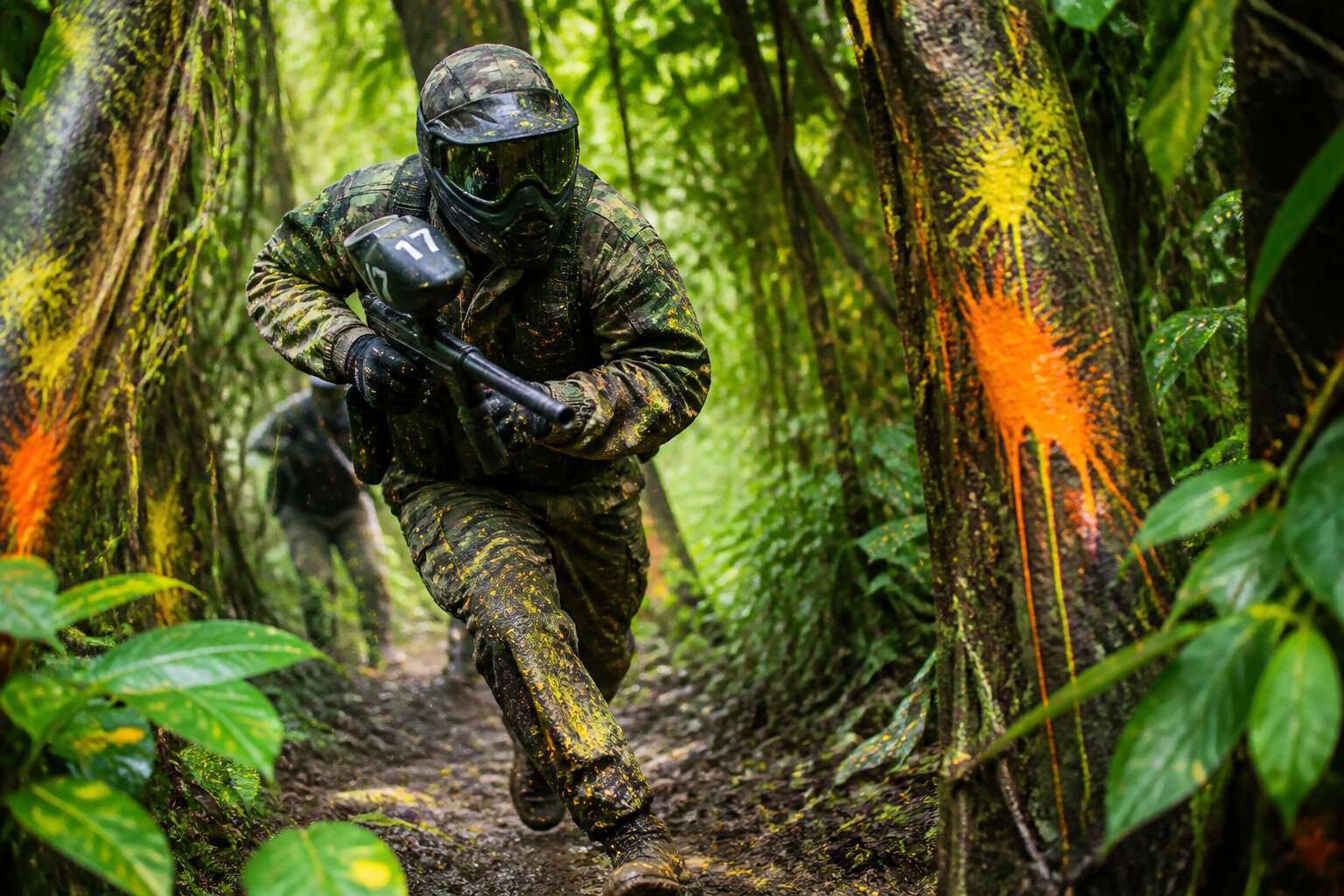
Decoding the Green Maze: Understanding Dense Woodland Terrain
Key Characteristics of Overgrown Natural Arenas
The South African bushveld and coastal dune forests yield some of the most demanding paintball jungle arenas in the world. Dense woodland terrain creates a layered battlefield where canopy thickness limits visibility to a mere fifteen metres on many days. Undergrowth, from invasive lantana to knee-high ferns, swallows paintballs mid-flight and muffles every footstep. Fallen acacia branches and exposed root systems provide natural cover, yet they also punish careless movement with painful trips and snags.
Key characteristics of overgrown natural arenas include:
- Multi-layered foliage that breaks up player silhouettes
- Narrow game trails that funnel movement into predictable lanes
- Thick leaf litter that makes silent approach impossible
- Termite mounds and shallow gullies that alter sightlines dramatically
A paintball jungle in this terrain changes weekly, as seasonal rains push new growth and animals reshape the undergrowth.
How Thick Foliage Alters Visibility and Engagement Distances
Standing at the treeline of a South African bushveld arena, I notice how the green swallows depth. Fifteen metres is generous. In a paintball jungle, your marker’s effective range matters less than your ability to read shadows and movement between the trunks.
Engagement distances shrink when lantana thickets and secondary growth compress the battlefield. You will rarely spot a player standing still. You will see the flicker of a barrel, the shift of a boot, the sway of a branch with no wind. Those cues become your primary targeting system.
- Thick foliage reduces engagement distances to under ten metres
- Canopy density can cut ambient light by up to 60 percent, altering paintball flight perception
- Sound becomes a secondary rangefinder when visual contact fails
Adjusting means treating every clearing as a kill zone and every shadow as a possible muzzle. A paintball jungle in dense woodland rewards patience, not speed!
Reading the Landscape: Identifying High-Traffic Paths and Ambush Zones
In any paintball jungle, the terrain itself is the first combatant. Animal tracks, eroded gullies, and the worn earth beneath overhanging branches mark the paths players will instinctively take. These corridors are the arteries of the battle, and they lead straight to ambush zones.
- Look for freshly broken spider webs across a trail
- Listen for the rustle of guinea fowl scattering ahead
- Check the mud for fresh boot prints or drag marks
Reading the landscape means identifying where these high-traffic paths bottleneck. A fallen marula tree or a sudden thicket of sekelbos creates a natural choke point. Players will filter through these gaps, one by one, and that is where the ambush unfolds. The green maze is not random; it is a network of predictable routes and hidden kill boxes. In a paintball jungle, the player who reads the terrain controls the fight.
Gearing Up for the Wild: Essential Equipment for Woodland Combat
Selecting the Right Marker and Loadout for Brush-Filled Fields
In the paintball jungle, your marker defines your range of motion. A long barrel snags on vines; a compact one lets you pivot through narrow gaps. Accuracy matters less than the ability to bring your barrel to bear in a second.
Your loadout must favor speed over volume. Heavy pods slow your sprint, and fumbling for paint when a player flanks you is fatal. I run a small hopper and a tight pod pack, with a squeegee clipped to my harness. Brush-filled fields clog barrels at the worst moments.
When choosing gear, I ask what I can carry while still crouching low:
- Compact markers with responsive triggers
- Masks with anti-fog lenses for humid air
- Gloves with reinforced palms for muddy grips
The right setup integrates with your movement. The paintball jungle punishes excess weight and hesitation.
Camouflage and Apparel: Blending Into the Natural Environment
In the South African bushveld, camouflage begins with silhouette disruption, not color matching alone. The paintball jungle presents a backdrop of mottled leaves, bark, and shifting shadow. A flat khaki shirt against dappled shade still reads as a human outline.
Choose apparel according to the specific canopy. For Highveld thornveld, vertical stripes mimic tree trunks. For dense coastal bush, layer darker greens and browns. Avoid shiny fabrics; they catch the low sun and betray your position.
My own kit includes a ghillie hood for static sentinel roles, but I remove it during movement. Full ghillie costs sprint speed and snags on branches.
A practical woodland loadout contains:
– A soft-shell jacket in mottled earth tones
– Cloth scraps of local foliage taped to shoulders
– Fingerless gloves that preserve trigger feel
– A neck gaiter for exposed skin
The paintball jungle rewards players who disappear before the first shot lands.
Protective Gear That Holds Up Against Roots, Rocks, and Rough Terrain
The South African bushveld has a mean streak. One misstep on a hidden root and you’re face-down in red sand with a bruised ribcage. The paintball jungle destroys flimsy gear without mercy. Your protective kit must absorb impacts and shed thorns.
I learned this lesson after a sliding dive turned my elbow into a pincushion of acacia spikes. Now I treat padding like a religious practice!
Essential pieces that survive the wild:
- Hard-shell knee pads that pivot with your movement
- A chest protector that breathes during sprints
- Reinforced gloves with padded knuckles
- Boots with ankle support and grippy soles
The paintball jungle rewards players who stay mobile, but mobility means nothing when you’re limping after the first engagement. Durable protection keeps you in the fight instead of hobbling back to the staging area.
Must-Have Accessories: Pods, Remote Lines, and Barrel Covers for the Wild
A paintball jungle hides your mistakes in the brush, but not in the open. I have seen a player sprint twenty metres, pull his marker up, and hear nothing but a click. A blocked barrel cover cost him the round. The accessories you carry matter as much as the marker in your hands.
Pods need to sit flush against your hips, not rattle with every step. A remote line routed under your jersey stays clear of acacia thorns and keeps your profile narrow. A barrel cover with a tight seal protects against sand and leaf litter.
In the paintball jungle, I rely on:
1. A pod pack with a low-profile silhouette
2. A swivel remote line that does not kink
3. A pull-through barrel cover attached to a lanyard
Each component has a specific purpose. Without them, you are simply carrying gear. With them, you stay ready for the next engagement.
Mastering Movement and Stealth in the Green
The Art of Slow Movement: Avoiding Detection in Dense Cover
Every step in a paintball jungle announces your presence to anyone listening. The rustle of leaves, the snap of a twig, the swish of a branch against your marker. In thick brush, your greatest opponent is not the opposing team, but your own haste. Slow movement transforms you into part of the environment, a shadow that shifts only when the wind does.
To move without detection, focus on the ground before each footfall. Place your heel down first, then roll your weight forward. Test each patch of leaves with your toe. Avoid grabbing trunks for support, as dead bark crumbles with a telltale crack. Instead, use your thighs to lower yourself gradually into cover.
- Pause after every three steps to listen
- Align your marker along your body to reduce snagging
- Breathe through your nose to keep your chest still
Patience becomes your primary weapon. Dense cover hides you only if you let it. A hurried player tears through the green, but a deliberate one disappears into it. I have watched skilled opponents walk within five meters of my position, completely unseen, simply because they refused to rush. That discipline wins engagements before a single shot fires.
Using Natural Formations as Shield and Shelter
Natural formations offer what manufactured bunkers cannot: irregularity. A termite mound in the Lowveld, a sandstone outcrop, a fallen marula tree. They break up your silhouette with angles no inflatable cover can mimic.
In a paintball jungle, the earth itself provides the best armor. I have watched a single boulder hold off three attackers who could not find a clean angle around it. A termite mound rising from the undergrowth absorbs hits that would slice through brush. A sandstone ledge offers a firing position with built-in protection. Fallen trunks create channels you can crawl through, their root systems forming natural gunports.
Learn to read these formations before you need them. Note which ones face the likely engagement zones. A boulder with a clear sightline beats a thicket you cannot see through. The geography of the paintball jungle rewards players who treat every contour as a potential strongpoint.
- Test the angle of a slope before committing to it
- Check whether a formation hides you from both sides
- Use depressions for resupply and reloading
Close-Quarters Tactics for Tight and Twisty Trails
There is no honest stretch of trail in a paintball jungle. Every path bends, narrows, and folds back on itself, which makes close-quarters movement a matter of reading the ground rather than charging it.
Step with your weight on the outer edge of your boots. That keeps the quieter leaf litter under you and the noisy twigs to the side. Keep your marker up but tucked, and slow your breathing at each bend.
I have watched players sprint into a twisty trail, only to meet a waiting barrel. The fastest route in a paintball jungle is rarely the smartest! Tight trails channel opponents into predictable lanes, so every bend holds an exchange.
The fundamentals of trail movement:
- Pivot from your hips, not your feet
- Breathe through your nose to quiet your movement
- Trust your peripheral vision at close quarters
Flanking and Side-Route Maneuvers Through the Underbrush
The green spaces between trails are where paintball jungle matches are won. Most players treat thick underbrush as an obstacle. I treat it as a route. The trick is learning how the foliage behaves before you commit to a side lane.
When you push through a flank, you are not walking. You are negotiating. Each plant has a give. Some snap, some bend, some release seeds that hang in the air. I have learned to read which ones will betray me.
- Move at heel to toe pace when the canopy is low
- Slip sideways through gaps rather than forcing them open
- Pause every few metres to listen for paint hitting leaves
A successful flank in a paintball jungle depends on patience more than speed. The side route is never the shortest path, but it is often the one that ends with you behind the opposition’s line.
Knowing When to Hold: Patience as a Tactical Weapon
In a paintball jungle, the player who knows how to wait can change the outcome of a match. I have seen a single held position force an entire squad into a narrow trail. They gave away their angles because one person refused to fire too early.
Patience is not about freezing in place. It is about reading when the field tells you to pause. The sound of an opponent reloading, the sight of a branch that moves against the wind, these are cues. They tell you when the risk of revealing your position is greater than the chance of a clean shot.
For me, holding is the difference between reacting and controlling. The clock does not matter. What matters is who moves first and who makes the mistake.
Combining Firepower and Communication in the Wild
Establishing Clear Roles Within Your Squad
Inside a South African paintball jungle, a squad is only as effective as its communication. A marker aimed true means nothing if the teammate on your flank doesn’t know when to advance. I have watched a coordinated burst of fire break an ambush simply because someone relayed enemy positions under the noise of the guns!
Establishing clear roles before stepping onto the trail prevents chaos. Consider these positions for a brush heavy arena:
- A point man who reads the terrain and sets the pace
- A rearguard who watches for silent flankers
- A communicator who funnels sightings to the group
Each role channels information back to the squad, turning scattered movement into a single operation. Communication in the wild demands short, crisp calls rather than shouts across the leaves. When firepower and structure align, the paintball jungle rewards patience and precision over raw aggression.
Non-Verbal Signals: Hand Gestures and Whistle Codes That Work Outdoors
Verbal calls disappear in the rustle of leaves and the pop of markers. In a paintball jungle, a hand signal can hold an advance or call a retreat without giving away your position. Whistle codes work when line of sight fails. One short blast means freeze. Two means fall back. Three signals an enemy sighting. These codes remain clear when voices fade.
A simple system is easier to remember under pressure.
- Raised fist: halt and scan the trail
- Open palm pushed down: crouch low
- Two fingers pointed: enemy direction
Practice runs build the muscle memory that holds under fire. The squad that reads a raised fist instantly moves as one body. When the paintball jungle turns chaotic, non-verbal cues keep that unity intact.
Maintaining Formations and Spacing in Poor Visibility
In the paintball jungle, the snap of a twig carries further than a shouted order. Combining firepower does not mean everyone shoots. It means shooters fire while a spotter directs. I use radio callouts for target location, but maintain visual contact to avoid overcorrection.
Maintaining formations in poor visibility demands rigid spacing. My squad uses a diamond formation. Each player stays within arm’s reach of the next. We keep a constant rhythm, stepping only when the player before moves.
- Keep your muzzle pointed forward, never inward.
- Take a knee when you lose sight of the player ahead.
- Call friendly fire positions after every burst.
This spacing keeps the paintball jungle formation tight. When a marker pops off, the squad knows the direction and the position of every friendly player. Each step becomes a shared signal, and the formation holds even when the canopy swallows the sun.
Key Mistakes to Avoid When Fighting Among the Trees
Staying Put for Too Long: The Danger of Becoming Static
Standing motionless among the ferns feels strategic, yet it invites defeat. In the paintball jungle, the terrain shifts with each rustle, and your stillness makes you an easy target. Opponents circle and close in while you remain in place. The longer you hold a position, the more predictable your sightlines become.
This immobility also disrupts your squad’s rhythm. When one player freezes, formation gaps widen and communication weakens. A static player rarely sees the flanking move that matters most. Meanwhile, the paintball jungle favors players who move with the terrain and adjust before the situation changes.
Consider how quickly a hidden spot becomes a liability:
- Foliage that masked your approach now blocks your exits.
- The path you entered is now visible to opponents.
- Time reduces the cover’s protective value.
Every second you stay in one place gives the enemy more control, turning a temporary hideout into a likely elimination!
Underestimating Footwear and Grip on Slippery Ground
After a morning rain, the floor of a paintball jungle hides its hazards beneath leafy litter. Slick clay, wet tree roots, and smooth stones turn a simple retreat into a slide. Players who ignore their footwear spend more time regaining balance than returning fire. Worn tread or soft soles have no place on this terrain.
Grip mistakes that lead to eliminations:
- Stepping onto a slope without checking traction.
- Letting mud cake between the lugs of your boots.
- Trusting a dry-looking log that stays wet underneath.
I have watched a teammate fall face-first into a gully while carrying a pod pack. The paintball jungle gives no pause for recovery. Your feet set your shooting stance, and a stable stance wins the engagement. Choose boots with aggressive grip and test each step before you commit.
Burning Energy: The Importance of Hydration and Pacing
A body sheds a litre of sweat per hour in humid brush, yet many players carry more pods than water. The paintball jungle drains energy through every sprint and crawl. I have seen skilled markers turn sloppy in the second hour, not from opponent fire but from empty reserves. The terrain punishes haste; a poorly paced advance leaves you panting behind cover while the opposition holds clean sightlines.
Signs of energy debt appear without warning:
- Slower reaction to distant movement.
- Reduced accuracy on medium range shots.
- Shortening breath during extended exchanges.
Each cycle of burst and recovery compounds the strain. Without hydration, your legs feel heavier, and the dense foliage seems to close in. Energy debt shifts the advantage to any opponent willing to wait, and the paintball jungle rarely forgives a depleted player.
Leaving Your Flanks Exposed While Focusing on One Direction
Nothing clears a trail faster than an opponent slipping behind you while you admire one rustling bush. Tunnel vision will end your round in the paintball jungle. Your barrel points one way, your boots stay planted, and your back is exposed to the enemy’s best shot.
Flank discipline demands scanning in arcs. When the foliage shifts to your left, your instinct says to stare at it. Do not! Keep your marker trained on the middle lane and let a teammate investigate the movement.
Signs your flank is wide open:
- Your neck aches from one fixed sightline.
- Shots arrive from where your rear player was standing.
- You have not scanned behind you in the last ninety seconds.

0 Comments