
The Sporting Roots of Paintball
From Forest Marking to a Global Sport
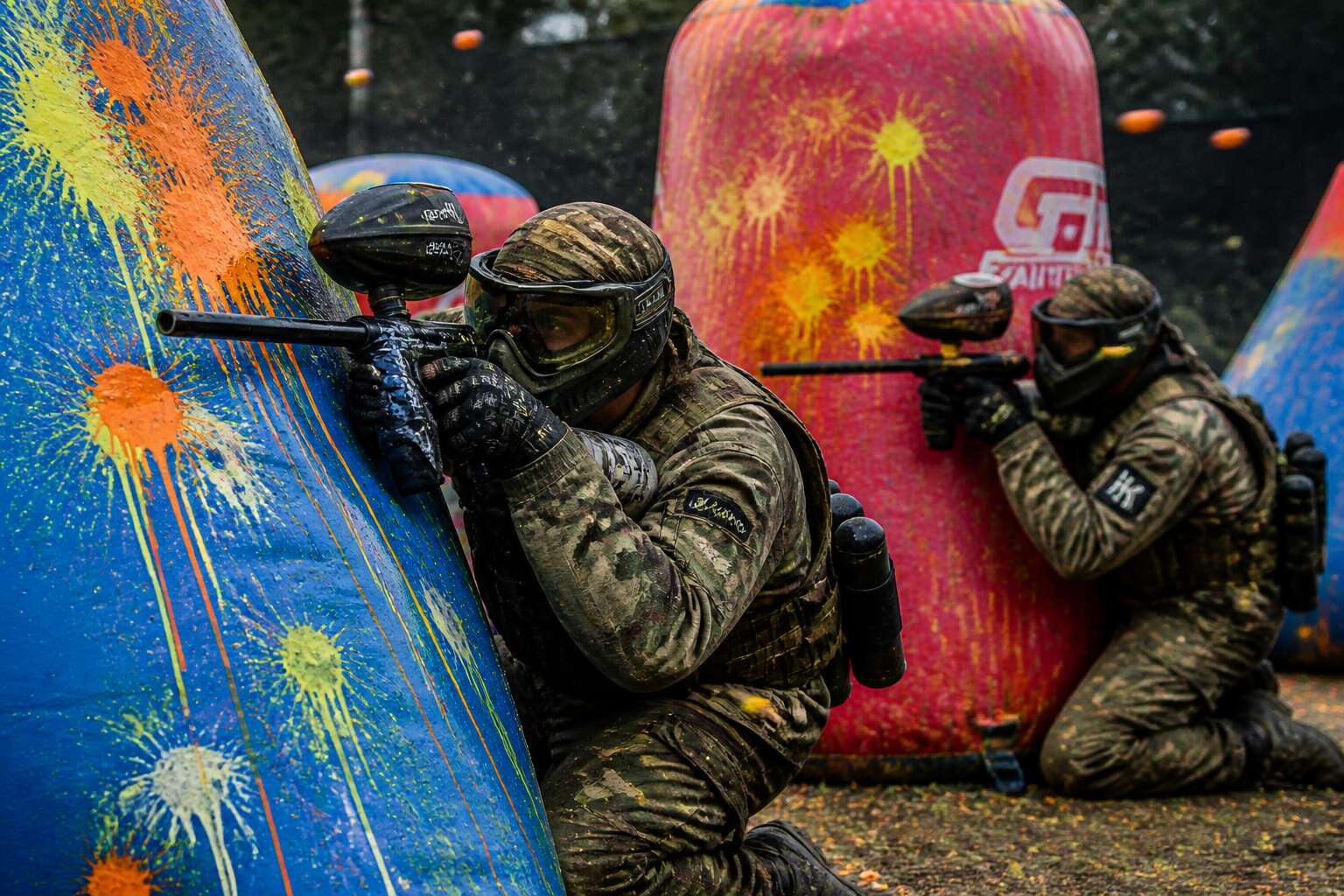
From its origins as a forestry device in the 1970s, paintball has evolved into a structured global sport. The original guns, designed for marking trees for timber operations, had no athletic purpose. By the early 1980s, competitive matches were taking shape in the forests of New Hampshire.
This transformation raises a question I frequently encounter: is paintball like war? Many observers glance at tactical gear and bunker layouts and assume a similarity. The governing structure, however, is entirely sporting.
Players compete under:
- League rules that prioritize player safety
- Equipment standards that limit projectile velocity
- Point systems that reward strategic teamwork
Leagues, referees, and official rulebooks place paintball firmly within competitive recreation.
Paintball as a Competitive Athletic Discipline
At its core, the question “is paintball like war” misses the athletic discipline unfolding on the field. I have watched players sprint across open terrain, lungs burning, eyes locked on a flag point. Competitive paintball demands cardiovascular endurance, rapid decision making, and precise hand eye coordination. Players move through structured zones, communicating through tactical calls, executing plays that resemble chess more than combat.
Modern tournament formats treat paintball as a sport of territory and objectives, not conflict. Matches run on timed clocks with flag captures and elimination points. The physical toll mirrors that of rugby or field hockey. Equipment is standardized for velocity and safety, ensuring projectiles cause no harm. So, is paintball like war? No, and quite emphatically so! It is a competitive athletic discipline with rules, referees, and leagues, built for sport, not battle.
The Rulebook: Boundaries, Objectives, and Referees
Every paintball field is defined by a written document. The rulebook draws the boundaries before the first shot is fired. Out of bounds, dead zones, and start boxes are marked with tape and netting. The objective, whether a flag capture or an elimination count, is published in advance.
Referees hold the real power. They check chronographs for velocity, inspect mask lenses for safety stamps, and punish overshooting or blind firing. A curse at a marshal can end a player’s weekend. The question of is paintball like war finds its answer here. War has no referee. War has no penalty card. War has only consequences without appeal.
- Boundaries are the first authority.
- Objectives define the match.
- Referees deliver the final word.
The match moves on whistles and clocks. When the buzzer ends the point, players lower their markers and walk off the field to shake hands. Sportsmanship, not combat, closes the day.
Tactical Similarities and Strategic Layers
Team Formations and Communication Patterns
Is paintball like war? The tactical layer offers the clearest answer. Players execute bounding overwatch, fire and maneuver, and terrain reading. These actions are not symbolic. They are direct translations of military doctrine to a competitive field.
Communication patterns reinforce the comparison. Squads use coded calls for enemy positions, reload status, and flank movements. I have watched a team spring an L-shaped ambush using hand signals alone. Strategic layers emerge through resource management, including paintball ammunition and time, plus control of map choke points. These dynamics ground the question of is paintball like war in observable fact.
- Fire suppression to fix opponents in position
- Flanking elements to fracture defensive lines
- Rear guard rotations to secure a withdrawal
Flanking, Cover Fire, and Objective-Based Play
Watch a team work the flanks and you will see the answer to the question, is paintball like war. Cover fire pins a marker down while a teammate slides through the kill zone. That movement forces the defense to split attention. Objective play adds another layer. A flag or a base becomes terrain worth dying for, and every push is a calculated risk.
Consider the tactical menu:
- Suppressive fire to lock an opponent behind cover
- A two person peel to extract a wounded player
- A fake push on one side to mask the real assault
These are not game mechanics invented for sport. They are drills lifted from small unit tactics. The comparison resolves in details: angles, timing, and the willingness to move when fire gets heavy.
The Role of Terrain and Environmental Awareness
Terrain shapes paintball more than any gear on your back. A patch of tall grass changes the rhythm of a match. When you cannot see the opponent, you rely on sound and movement. The question, is paintball like war, finds its answer in this constant environmental negotiation.
The land demands attention:
A low dip that hides a player until the last moment
A tree line that channels movement into a kill zone
A bunker that offers cover but also blocks escape
I have watched players lose matches simply because they ignored the ground beneath their feet. Experienced players read the field before the opening whistle. They note where shadows fall, where the wind shifts, where the grass is trampled. This awareness turns a simple field into a set of opportunities and traps. Without it, even the best shot becomes guesswork.
Adaptation Under Pressure: Decision-Making in Both Arenas
The question of whether is paintball like war often surfaces when players face sudden ambushes. Decision-making under pressure, even simulated pressure, separates those who freeze from those who react. In both arenas, seconds matter. You must choose between pressing forward or falling back without complete information.
Strategic layers emerge from this pressure. A squad leader reads the opponent’s patterns while individual players manage their own positioning. The same mental loop drives soldiers and paintball captains. Assess, decide, execute. Then repeat.
- Holding ground when the opponent holds better sightlines
- Breaking contact to regroup with teammates
- Switching objectives when the initial plan collapses
These choices resemble combat decisions, though the stakes differ. The adrenaline, the incomplete visibility, the weight of responsibility. Is paintball like war? In tactical rhythm, yes. In consequence, no. That distinction shapes how players train their instincts.
Where the Comparison Falls Apart Physically
Lethal Force Versus Non-Lethal Paint Projectiles
People often ask is paintball like war, but the physical disparity settles it. A paintball travels at around 300 feet per second, striking with a dull thud and leaving a welt. A military round travels at more than three times that speed, and its kinetic energy is calibrated to stop a human being permanently. That distinction is not academic. In war, a projectile disembowels or shatters bone. In paintball, a projectile splits open upon contact, releasing harmless fill. Here is the physical comparison:
- Paintball muzzle velocity: typically 280 to 300 feet per second.
- Lethal firearm muzzle velocity: 1,200 to 3,000 feet per second.
- Resulting effect: superficial bruising versus massive tissue destruction.
The non-lethal nature of paint projectiles transforms the entire risk profile, which is precisely why the question loses meaning at the point of impact.
The Absence of Explosives, Shrapnel, and Ballistics
War is defined by its explosives. Artillery shells, grenades, and improvised devices create blast waves that rupture organs. Shrapnel tears through bodies and walls indiscriminately. Paintball has none of this. No detonations. No secondary fragmentation. No high-explosive rounds. A paintball match uses gas-powered markers that launch gelatin capsules.
The physical differences are stark when placed side by side:
– A military round retains lethal energy for hundreds of meters.
– A paintball loses speed within dozens of meters and shatters on impact.
– Explosive ordnance produces overpressure and fragmentation; a paintball produces a welt.
The question is paintball like war collapses when you account for ballistics and explosives. There is no shrapnel to fear, no blast wave to outrun. No one ducks from incoming mortar fire. No one treats a bunker as protection against metal fragments. A paintball hits cover and bursts. In war, cover is the only thing between you and dismemberment.
Victim Psychology: Consequences of Being Hit in Real Combat
When a paintball cracks against your ribs, you feel a sting. When a bullet strikes a soldier, the mind floods with different signals. The body knows the difference between a welt and a catastrophic wound. That difference shapes everything that follows.
The psychology of being hit in real combat involves factors that no paintball match can replicate. This is the core truth when asking is paintball like war.
- The sound of your own blood leaving your body
- The smell of gunpowder and the knowledge that the enemy is still firing
- The realisation that you cannot raise a hand and walk off the field
- The weight of knowing your teammates must fight while dragging you to cover
A paintball player who takes a hit feels disappointment. A soldier feels his mortality press against his throat. One walks away with a bruise. The other prays the bleeding stops before his vision does.
The Reality of Injury: Paintball Bruises Versus Combat Trauma
A paintball bruise is a surface event. It appears within hours, aches for a day or two, and fades. Combat trauma is not a surface event. It rewrites the body’s architecture: muscles, bones, nerve pathways, and skin that never knit the same way again.
When someone asks is paintball like war, I point to the physical evidence. A player collects welts and jokes about them over a braai. A soldier collects scars that restrict movement, trigger phantom pain, and demand ongoing treatment.
- A paintball hit leaves a welt that clears without medical intervention
- A combat injury often requires surgery, rehabilitation, and permanent adaptation
Consider the two outcomes. A player walking off the field with a bruise. A soldier learning to walk again. The contrast answers the question is paintball like war.
Mental and Emotional Contrasts
Adrenaline Rush Versus Survival Stress
The adrenaline rush of paintball feels primal. It grabs your chest and sharpens your senses. But asking is paintball like war requires looking past the physical similarity. In paintball, you experience an adrenaline surge without the survival stress that grips soldiers in real combat. The psychological underpinnings are different.
Your brain understands the difference on a deep level. Paintball offers a temporary spike of excitement. Combat creates a sustained state of survival stress, where every sound and shadow carries potential death. The rush is similar. The weight behind it is not.
When a paintball strikes you, you feel the sting and the disappointment. In combat, a hit means blood, pain, and the fight for survival. Having played both paintball and simulated military exercises, I can tell you that the gap between these mental states is enormous.
The Stakes: Losing a Game Versus Losing a Life
The stakes define the emotional texture. Losing a paintball match means a bruised ego, a bruised forearm, and a polite handshake. Losing a life ends the conversation entirely. So is paintball like war? Only if you mistake a scraped kneecap for a casualty report.
The emotional contrast is stark. In simulated exercises, I have seen players rage over a flubbed objective. That rage evaporates with the next match. The psychological stakes of paintball are transactional. You pay your entry fee, you lose, you buy a pie at the tuckshop.
Combat loss carries a different consequence:
- A game loss ends with a referee’s whistle.
- A life loss ends with a body bag.
Your brain processes the threat differently. The absence of fatality changes the emotional investment. When the whistle blows, you shrug. When the rounds stop, you grieve. The question of is paintball like war resolves itself in that contrast.
Moral Weight and the Ethics of Targeting Opponents
Pulling the trigger in a paintball field carries a reversible moral weight. The opponent agrees to be marked, and that consent strips the act of permanence. In war, the target is an enemy. In paintball, the target is a player whose exit is a red mark. So is paintball like war? The mental contrast appears in the ethical calculations. You weigh angles, not legacies. The moral burden is delegated to the referee.
This shift changes the emotional texture of aiming:
- You aim to eliminate a participant.
- You aim to extinguish a person.
- One requires a handshake. The other requires a reckoning.
The ethics of targeting opponents in a paintball match rest on a shared rulebook. That rulebook dissolves under real fire. You carry the emotions differently when the target can laugh it off. That is why is paintball like war remains a question of conscience.
Post-Game Reflection Versus Lasting Psychological Scars
After the mask comes off, the paintball player replays the moves with teammates. That reflection is light, a story of angles and near misses. By morning, it is gone. The body bears a bruise, but the mind moves on.
Combat changes the equation. The psychological scar is not a story, it is a permanent alteration. So is paintball like war? Only if you ignore what follows the firing. One person feels the giddiness of a game well played. The other feels the memory of a life carried forward. That difference is the real boundary.
Camaraderie in Sport Versus Bonds Forged in Combat
The laughter in a paintball safe zone has a different texture. It is the sound of people who chose to be there. We high-five after a win, but the connection rarely extends beyond the parking lot. Combat bonds are heavier. They are carved by necessity, by watching a friend do something impossible under fire.
When a paintball player misses a mark, the team adjusts tactics. When a soldier misses, someone may pay a price. That weight changes what the word “brother” means. Is paintball like war? Not in the emotional ledger. The sport gives us a glimpse of teamwork. Combat builds a dependency that never fully releases.
Equipment, Safety, and the Experience Gap
Protective Gear in Paintball: Goggles, Padding, and Markers
Is paintball like war? Hold a marker and you will notice the difference. A paintball gun is a precision instrument, not a firearm. My goggles are sealed, my padding covers my chest and shins, and the marker shoots a fragile sphere of paint! War equipment is built to kill. Paintball gear is built to protect and mark.
Safety requirements in paintball are strict. Referees inspect every marker. Velocity limits are enforced. Players wear masks that withstand blunt force. That level of control does not exist in combat. The experience gap begins with the gear you put on your body.
- Thermal lenses prevent fogging
- Padded gloves shield your hands
- Elbow pads allow sliding on rough ground
Weapons of War: Automatic Rifles, Grenades, and Night Vision
Shoulder an automatic rifle and the question of is paintball like war answers itself. A paintball marker lobs gelatin spheres at 280 feet per second. A rifle sends a copper-jacketed round at nearly 3,000 feet per second. The former leaves a welt. The latter destroys tissue.
Grenades have no paintball equivalent. There is no shrapnel, no blast wave, no concussive force that rearranges a room. Night vision amplifies ambient light so soldiers can identify threats in the dark. My paintball goggles, even with thermal lenses, cannot do that.
The equipment gap creates what veterans call the experience gap. Consider a soldier’s loadout:
- 210 rounds of ammunition
- Fragmentation grenades with a 15-meter lethal radius
- A sidearm for close-quarters emergencies
None of that has a paintball analogue! The marker is visibly a sporting device. Is paintball like war? Inspect the hardware and the answer becomes clear. War equipment exists to end life. Paintball equipment exists to end a point.
Safety Standards on Paintball Fields Versus Military Combat Rules
At a paintball field, safety is enforced before the first shot. A chronograph measures every marker’s velocity, and masks are mandatory beyond the staging area. Military combat rules are entirely different. They are built around mission success and force protection, not recreational risk management. The difference becomes obvious when a referee calls a hit. Both players stop, raise a hand, and walk off the field. In a firefight, stopping is not an option.
The experience gap follows from these contrasting standards. Soldiers train for split-second decisions where hesitation can be fatal. Paintball players train for split-second decisions where hesitation costs a point. That shift in consequences changes everything.
Consider these typical field regulations:
– Full-face masks required at all times
– Marker barrel covers when not in play
– Surrender rules at close range
None of these have a military parallel. The soldier doesn’t ask the enemy to surrender from a distance because they’re too close. So is paintball like war? In equipment, no. In rules, no. In the way your heart pounds when paint flies past your ear, maybe it comes close. But only close.
The Cost and Accessibility of Each Experience
The real divide shows up when you compare what it costs to step onto a paintball field versus stepping into a military role. For a few hundred rand, you can rent a marker, buy a bag of paint, and play for an afternoon. That accessibility is the sport’s strength. But the equipment itself tells a different story. A paintball marker is a precision toy built for sport. A service rifle is a tool of lethal force, and you cannot buy one at a retail counter.
Safety also separates the two experiences. On the field, masks and chronographs protect every player equally. The military does not offer safety gear to the enemy. So is paintball like war? Look at the cost of a mistake. Paintball gives you a bruise and a walk to the staging area. Combat gives you a casualty report. That gap in consequences is the reason the experiences remain fundamentally different, and it makes the question is paintball like war impossible to answer with a single word.
The Verdict: A Game That Borrows, Not Replicates
Why Paintball Feels Military Without Being Military
The question of is paintball like war gets a clear answer when you watch players between rounds. They laugh, compare welts, and plan the next scenario. No soldier behaves that way after combat. Paintball uses the visual grammar of conflict, but it operates on a different grammar entirely.
The game borrows the surface. It takes the shape of a firefight, the vocabulary of tactics, the weight of a marker in hand. It leaves behind the temporal reality. War has no clock. War has no referee. War does not reset.
What paintball borrows:
– The silhouette of a rifle
– The cadence of movement
– The echo of command
What it cannot replicate:
– The weight of permanence
– The fatigue of prolonged operations
– The unpredictability beyond the field
Paintball compresses conflict into a contained performance. That is why it feels military without being military.
How Military Training Actually Uses Paintball Simulations
Military training uses paintball simulations for one reason only: to build instinct. Soldiers practice room clearing, ambush reactions, and extraction movements with paintball markers because the feedback is immediate and the cost is negligible. The question is paintball like war becomes easier to answer when you watch a squad rehearse a breach. They are not rehearsing violence. They are rehearsing coordination.
These exercises hammer down the mechanics of movement and communication.
- Room clearing drills
- Ambush response patterns
- Team extraction movements
The simulation gets soldiers comfortable with the chaos of short-range engagements without the permanence of ballistics. Even so, the military never confuses the drill with combat. No training officer calls a paintball hit a casualty. The verdict stands: paintball borrows the shape of firefights while leaving behind the weight of consequence.
The Public Perception: Hollywood’s Influence on the Comparison
The verdict on is paintball like war comes down to surface resemblance. Paintball borrows the geometry of firefights, the angles, the cover, the snap decisions. But it strips away the permanent cost. That difference matters more than any similarity in equipment or uniforms. What remains is a game with military aesthetics.
Public perception cannot escape Hollywood. Action films trained audiences to equate paintball with combat because both feature masked figures, tactical movements, and sudden bursts of paint or fire. Directors stage paintball sequences to mimic war scenes, creating a feedback loop of imagery. This shapes how players see themselves on the field.
- endless ammunition that never runs dry
- heroes who absorb hits without flinching
- clear victories decided in a single frame
These cinematic shortcuts blur the line further. Ask someone is paintball like war, and the answer reflects cinema more than combat. The verdict stands: paintball borrows the look of war, not its reality.
Appreciating Paintball for What It Is: A Strategy-Filled Sport
The real answer to is paintball like war is no, and that is precisely the point. War demands lethal force; paintball demands movement, communication, and nerve. The borrowed aesthetics fade once you feel the sting of a welt and laugh it off. On any South African field, from Durban to Pretoria, you will see players chase objectives, not enemies. Paintball is a strategy-filled sport where the only casualty is your pride.
Three things define paintball:
- A clear objective that can shift each round
- Terrain that rewards creative flanking
- A referee who enforces fair play
These elements transform a military look into an athletic contest. When someone asks is paintball like war, the honest reply is that war has permanent stakes. Paintball has a whistle to end the round, which changes everything.
0 Comments