
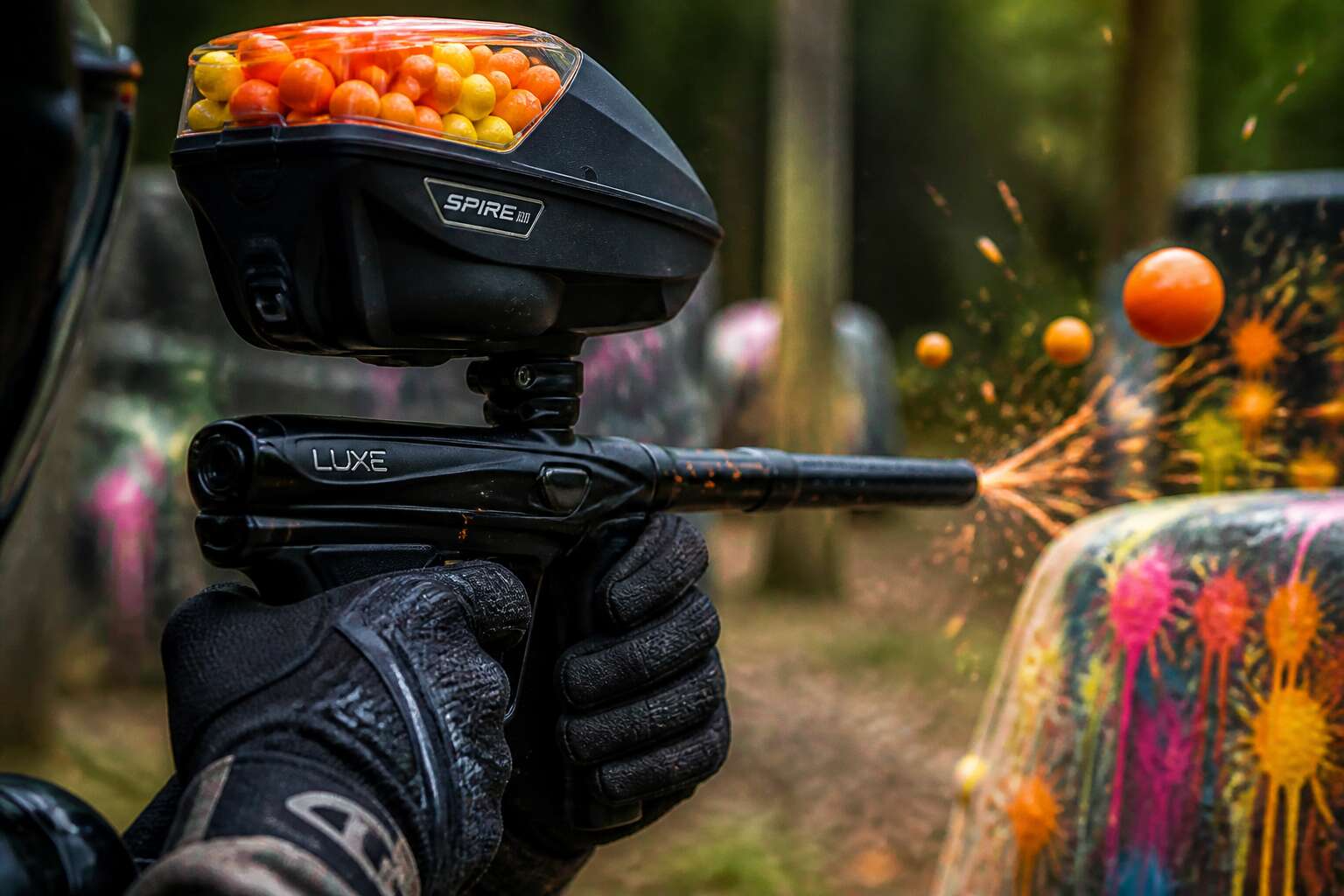
Marker Types and Styles
Mechanical Markers: The Reliable Workhorses
Relying on a mechanical marker removes a layer of complexity that can sometimes distract from the pure act of play. These systems are the workhorses of the sport, using a spring and hammer to strike a valve. This sends a high-pressure burst down the bolt to launch a paintball gun projectile. The predictability of this cycle offers a consistent feel, shot after shot, without the need for a circuit board to interpret your trigger pull.
The internal architecture is remarkably straightforward. You can trace the path of the bolt, the action of the hammer, and the flow of gas with a clear understanding. This simplicity translates to a lower risk of malfunction in the dusty South African bush. Because there is no solenoid or battery to drain, the firing response is instant and unwavering. For many players, this raw, mechanical connection to the physics of the game is exactly what they seek.
Consider the maintenance and ownership angle. A mechanical paintball gun often has fewer fragile parts that can fail during a crucial move. Players can usually strip down the frame and bolt assembly with basic tools. This accessibility is a major draw for those who prefer to handle their own tuning and upkeep.
– The trigger pull is direct, providing a tactile sensation that electronic triggers often lack.
– The absence of circuit boards makes the marker less susceptible to moisture and impact damage.
– These markers often offer a lower operating pressure, which reduces wear on paintballs and improves accuracy.
A mechanical marker requires you to understand its operation. You must adjust the velocity by changing the spring tension or input pressure. This hands-on approach builds a deeper awareness of how velocity and trajectory interact. Your aim becomes more deliberate. The lack of programming options forces you to refine your technique on the field, relying on instinct and fieldcraft to outmaneuver opponents.
Electronic Markers: Speed and Precision
Electronic markers flip the script on trigger discipline. Instead of a hammer striking a valve, a solenoid opens and closes on command from a circuit board. The result is a paintball gun that can cycle faster than a human finger can physically pull a trigger. For players chasing tournament-level firepower, this is the defining upgrade.
The precision lies in the programming. You can set the marker to burst, ramp, or fully automatic modes, each with its own personality. Some even allow you to adjust the debounce, so the trigger responds to the slightest touch.
– Ramp mode rewards aggressive play by letting you walk the trigger.
– Burst mode fires a set number of shots per pull.
– Semi-automatic keeps it simple, but with electronic speed.
Battery life requires attention. A drained battery means a useless paintball gun on the field. Yet the payoff is a shooting pace that mechanical systems cannot match.
Pump-Action Markers: The Skill Challenge
Nobody buys a pump-action paintball gun for convenience. This is a marker built for masochists with good aim. You get one shot per pump, and missing becomes a personal failure. No circuit board will save your pride.
- It forces you to choose each shot wisely
- It builds core skills that electronic markers let you ignore
- It turns you into a patient predator
Pump shooters are not for everyone. They demand deliberate movement and a thick skin for mockery. When you hit your target, though, the quiet that follows is deeply satisfying. Just keep your fingers clear of the moving parts.
Magfed Markers: Realism and Strategy
Feeding from a magazine changes everything. A magfed paintball gun holds fewer rounds than a hopper-fed model, so every trigger pull becomes a financial decision. You shoot less, move smarter, and the game turns into a tactical challenge. Magfed markers accept real-style magazines, often CO2 or compressed air.
Some players even run with vest pouches stuffed with spare mags. This is realism for people who think speedball looks too much like tennis. The strategy shifts to angles, cover, and communication. I have seen a single player pin down three opponents simply by refusing to waste paint.
That is the essence of magfed play! It rewards patience and punishes impulse. You become a sniper, a scout, or a decoy. Just remember to seat your mags correctly, because fumbling under fire is humiliating.
Core Components That Matter
Barrel Length and Bore Size
The relationship between barrel length and bore size determines your paintball gun’s consistency. A longer barrel gives propellant gas more time to expand, producing a steadier push on the ball. Conversely, a shorter barrel accelerates the paintball faster but can introduce turbulence. Bore size, measured in thousandths of an inch, matters because gelatin shells vary slightly in diameter. A tighter bore aligns the ball precisely; a looser one reduces friction.
Consider how these factors interact!
- Longer barrel: higher muzzle velocity with lower air consumption.
- Tighter bore: improved accuracy with more cleaning required.
- Shorter barrel: quicker handling in close quarters.
The most effective setup depends on your style. For a South African player navigating bushveld terrain, a compact barrel might serve better than a long precision barrel. Tuning these core components alters the marker’s behavior.
Bolt Systems and Efficiency
The bolt system controls the air path in a paintball gun. A heavy bolt requires more gas to cycle, which drains the tank faster. Lightweight, low friction bolts move quickly and use less air per shot. In South Africa, where fill stations are often far from the field, efficiency affects how many sessions you can play in a day. I have watched players swap a stock bolt for a balanced aftermarket option and gain an entire pod of paint per game.
Open bolt designs rest the bolt to the rear, which simplifies loading but vents gas. Closed bolt systems hold the ball firmly inside the breech, delivering consistent velocity with extra moving parts. Some bolts use soft face tips to reduce chopping and preserve gas economy. A lower operating pressure in a paintball gun lowers recoil and noise, helping you stay aware during bushveld skirmishes.
Trigger Mechanisms: Mechanical vs. Electronic
What does your trigger finger actually feel? On a mechanical trigger, you pull a sear, a direct metal connection that breaks. On an electronic trigger, a microswitch sends a signal to a solenoid, and the shot fires with a delayed click. That difference changes how you plan every move!
In South Africa, many players prefer mechanical triggers for their predictable feel. Electronic triggers reward speed but require battery care and more maintenance. When choosing a paintball gun, think about your local conditions and patience for upkeep.
- Mechanical triggers offer instant response and reliability in dusty conditions.
- Electronic triggers allow adjustable sensitivity and rapid firing rates.
My time in the bushveld showed me that a worn mechanical trigger can outlast an electronic board. But a well tuned electronic trigger gives an edge in close quarters. Both have value.
Hoppers and Loaders
Every paintball gun relies on the hopper mounted above the feed neck. That plastic vessel stores paint and releases it into the breach. In South Africa’s heat, cheap hopper shells warp and jam. A loader that cannot keep pace strands you mid-exchange.
Gravity feed units are quiet, simple, and slow. They suit mechanical markers. Agitating loaders stir paint and offer a middle step. Force-fed loaders, battery driven, push rounds with steady pressure. They cost more, but they deliver.
- Gravity hoppers: light, no power, slow.
- Agitating loaders: moderate speed.
- Force-fed loaders: fast, consistent.
Air Systems: CO2 vs. Compressed Air
In the dry heat of the South African Highveld, CO2 turns temperamental. A paintball gun fed by liquid CO2 suffers velocity swings as the tank cools. First shots fly fast, later ones drop short. Compressed air eliminates that drama.
Compressed air, or HPA, stores gas at high pressure without phase change. You get consistent power between shots. I have felt the difference on a long skirmish. The tank costs more to fill, but your aim stays true.
- CO2: cheap, common, unreliable in heat
- Compressed air: stable, smooth, requires a hydrotest
Most serious players choose HPA for their paintball gun. The upfront price for a carbon fiber tank is steep. The payoff is control that never fades with temperature.
Choosing the Right Marker for You
Matching Marker to Playing Style
Your paintball gun is not a fashion accessory. It is a tool that must match how you actually move on the field. A player who charges bunkers needs something different from one who hangs back and picks shots. The gap between what you buy and what you need causes frustration.
Consider your natural tempo! Do you sprint, slide, and fire on instinct? Or do you hold angles, wait for mistakes, and make every shot count? Your answer narrows the options. Think about physical weight. In my experience, a heavier marker feels solid in the shop, but after six hours in the sun, it becomes a burden.
A quick self-assessment helps:
- How aggressive are you on the field?
- How often do you shoot versus reposition?
- How much maintenance can you tolerate?
Answer those honestly and the right paintball gun becomes obvious.
Budget Considerations for Beginners
The first paintball gun you buy will teach you more about your habits than any product review. New players often assume a bigger price tag means better performance. In practice, a mid-range marker with a good air system handles the South African heat better than a flagship model that drains batteries by midday.
Focus your budget on what keeps you on the field. Consider these essentials:
- A mask that does not fog up, because visibility beats firepower.
- A paintball gun that accepts both CO2 and compressed air without major reconfiguration.
- A spare parts kit, since local suppliers can take weeks to ship.
Extra barrels and electronic triggers can wait. I have seen too many beginners drop R4,000 on a marker, then skip a day because their hopper leaked. Start lean, play more, and upgrade only when you feel a real limitation.
Rental vs. Owning Your First Marker
Renting a marker is a smart way to test the waters before you commit. Most South African fields offer decent rental guns, but they have seen heavy use. A rental paintball gun will show you the basics, yet it rarely performs consistently. Owning your first marker changes that relationship. You learn its quirks, its air efficiency, and its maintenance rhythm.
Consider these three questions before buying:
– How often do you realistically play per month?
– Does the field offer compressed air refills on site?
– Are you willing to strip and clean after every session?
If you only play twice a year, rental fees stay low. If you play monthly, ownership pays off. The real cost lies in accessories, not the marker itself.
Upgradability and Customization
Choosing a marker is an intimate decision. Your paintball gun will consume weekends and demand patience. I have seen players buy a flashy electro only to abandon it after a season. The marker that fits your routine is the one you will actually maintain. Ask yourself what the field offers and what your hands prefer.
Upgradability matters more than raw speed. A paintball gun with standard threads accepts new barrels, triggers, and internals. Consider local availability in South Africa. Shipping specialised parts can double the cost. Look for common platforms with aftermarket support.
- Ask your field’s pro shop which parts they stock.
- Check online forums for reliable upgrade paths.
Customisation is a process of learning. Every screw you turn teaches you something about mechanics and your own limits. Buy a marker that grows with you, not one you will outgrow in three months.
Ergonomics and Weight Distribution
The single most underrated feature on a paintball gun is how it feels when you raise it. A marker can fire thirty balls per second, but if the weight sits forward, your arms tremble by midday. South African fields, especially the bushveld layouts, demand hours of holding your gun ready.
Weight distribution changes movement. A rear-heavy marker lets you run with the barrel down. A front-heavy gun pulls your aim low. Spend time in a pro shop with a bottle attached. Feel the difference between a full tank and an empty one.
Ergonomics cover more than weight. Grip angle, trigger reach, and foregrip spacing affect your natural point of aim. Small hands struggle with thick frames. Long fingers wrap awkwardly around slim regulators.
A well balanced paintball gun lets you focus on the game rather than the equipment.
Brand Reliability and Support
Brand reliability and support often decide how a paintball gun performs years after purchase. A marker from a manufacturer with local distributors means faster turnaround on service. South African players face dust and heat that punish fragile seals. Brands with established support networks in Johannesburg or Cape Town can source parts quickly.
Consider warranty coverage before committing. Some manufacturers offer comprehensive packages that include bolt replacements. Others leave you hunting for third-party solutions. Ask around at your home field. Players tell you which brands hold up under real conditions.
A simple checklist before buying:
- Local parts availability
- Warranty terms and service centres
- Community reputation among South African players
The cheapest paintball gun becomes expensive when parts take weeks to arrive.
Care, Maintenance, and Troubleshooting
Cleaning After Every Day of Play
After a long day on the field, your paintball gun carries more than battle scars. Paint residue and lubricant breakdown silently affect performance. I have seen markers fail the next morning simply because owners skipped this ritual. A thorough cleanup after every session is non-negotiable.
Start by releasing all air pressure. Then disassemble the bolt and breech. Wipe every surface with a microfiber cloth. For stubborn paint, use warm water, never solvents. Reapply a thin layer of marker oil to moving parts.
Here is the daily sequence:
- Remove the barrel and clean it thoroughly
- Inspect the detents for wear
- Lubricate the bolt and hammer
- Reassemble and test with dry fires
Storing a dirty marker invites corrosion, especially in humid regions. Troubleshooting becomes easier when you start from a clean baseline. Trust that discipline.
O-Ring Care and Replacement
An O-ring the size of a grain of rice can silence the most expensive paintball gun on the field. These humble elastomers seal every moving part, and in South Africa’s dry heat or coastal humidity, they degrade faster than owners expect. I have replaced thousands of them. The process rewards patience.
Inspect rings before every event. Run a fingernail around each surface. Cracked or flattened rings cause velocity drops and air leaks. When replacing, remove the old ring with a plastic pick. Metal tools cut the seating groove. Install the new ring dry. Lubricate after seating, never before.
Here is the sequence I use:
1. Remove the bolt assembly
2. Replace all rings on the bolt
3. Check the valve and regulator rings
4. Reassemble with a thin oil film
A spare kit costs less than a day’s paint. Carry one always, and your paintball gun will keep its breath through the longest tournaments. Neglect these rings and you will chase phantom leaks all season.
Lubrication Points and Techniques
A failing paintball gun usually comes from excess lubricant, not dirt or wear. Oil migrates into airways, collects dust, and turns into grinding paste. Players assume more oil means smoother operation. The opposite is true. I have seen players chase velocity issues caused by two extra drops.
Lubrication points divide into two categories. Sliding surfaces need grease. Sealing surfaces need silicone oil. Grease stays where applied. Oil flows and coats everything downstream, so one drop on the valve changes velocity all day.
- Bolt and its rear bumper
- Hammer and hammer bore
- Valve stem and its seal
- Regulator piston
Apply grease to the bolt’s contact rails. Apply oil to the valve stem. Most markers perform best with a film so thin it appears dry. In South Africa’s varied climate, the same paintball gun behaves differently in Durban’s humidity than on the Johannesburg Highveld. Adjust viscosity accordingly, and always chronograph after any lubrication change.
Storing Your Marker Properly
A paintball gun left in a Durban car boot for a month will never shoot the same. Heat softens seals, moisture seeps in, and the velocity curve flattens. Storage is a discipline, not an afterthought.
The air tank comes off, the hopper empties, and the bolt sits forward to release spring tension. The local climate dictates the rest. Durban’s humidity attacks o-rings, while the Highveld’s dry air cracks them. A cooled, ventilated case holds the marker between days.
- Store upright or horizontal.
- Add a desiccant sachet.
- Wipe the exterior with a silicone cloth.
A monthly check prevents surprises. A paintball gun that chronographs straight from the cupboard is the prize of a disciplined player.
Staying Safe and Legal on the Field
Essential Protective Gear
Eye injuries account for a disproportionate share of paintball accidents. The mask is the first thing you should buy, even before a paintball gun. It should be thermal, anti-fog, and rated for impact. I have seen players lose their passion after one reckless afternoon, trading a lifetime of play for a blurry memory.
The legal side is less dramatic but just as consequential. In South Africa, paintball fields operate under provincial and municipal regulations. Confirm the site carries liability insurance and adheres to local safety standards. Every paintball gun should be chronographed before play, and the velocity must read below the field’s limit. Safety is a discipline, not a suggestion!
Essential protective gear includes:
- Full-face mask with thermal lens
- Neck protector
- Gloves with padded knuckles
- Knee and elbow pads
A player who trusts their gear plays with clarity. A player who doubts it hesitates. That hesitation is where accidents happen.
Barrel Covers and Sock Rules
A barrel cover costs little. It stops your paintball gun from firing when you do not intend it. Without it, an accidental trigger pull becomes a projectile aimed at a teammate. South African fields enforce this without exception. The cover goes on the moment you leave the playing field! It stays on until a referee signals the start.
Field rules govern every transition. Some venues demand a barrel sock as backup, especially during chronograph testing. Know the difference:
- Barrel covers slip over the muzzle and block paint from exiting.
- Barrel socks wrap around the entire barrel and catch the shell if fired.
Both are mandatory. I trust a player who checks their barrel cover before their hopper. A player who respects these rules never apologizes for a wild shot.
Velocity Limits and Chronograph Testing
A paintball gun firing above 300 feet per second can break skin. South African fields enforce velocity limits with chronograph testing before every game. The chronograph measures each marker’s speed. If your paintball gun registers too hot, you walk to the tuning bench.
- Most fields cap velocity at 280 fps for open play.
- Tournament markers might need 270 fps to prevent bouncing.
Referees perform these checks randomly during the day. A marker that passes in the morning can drift after lunch. Temperature changes affect air pressure. I have seen players lose their game pass for skipping the retest, and it hurts to watch! Legal play depends on this simple machine.
Local Laws and Field Regulations
South African paintball fields operate under provincial safety regulations that reach far beyond the chronograph station. Your paintball gun must feature a working safety catch, and the barrel sock stays fixed whenever the marker leaves the live zone. Fields enforce minimum engagement distances too. When an opponent closes inside surrender range, you call the hit instead of pulling the trigger.
- Confirm the venue’s medical aid protocols before your first game.
- Ask whether the field mandates protective gear beyond the standard mask.
- Check age restrictions and parental consent requirements in your province.
Local municipalities sometimes classify paintball markers under firearm legislation. Owners should verify the Firearms Control Act and the specific bylaws in their area. A paintball gun with a realistic finish can draw unwanted police attention during transit. Keep it unpressurised inside a padded case with the barrel sock clearly visible.


0 Comments