
Choosing Your Sidearm
Spring-Powered Pistols
Very few sensations compare to the honest recoil of a spring-powered paintball pistol on a Karoo morning. Unlike gas or electric models, this sidearm asks you to master technique before speed. In South Africa, where dust and heat test every piece of gear, the simplicity of a coiled spring becomes a quiet advantage. You rarely hunt for seals or CO2 refills.
Still, choosing your sidearm means confronting the trade-offs. Every spring pistol has a distinct rhythm. Some demand a strong forearm, others reward a delicate touch. I have watched new players struggle with heavy cocking strokes, then fall in love once they adjust!
Before you spend your rands, examine these details:
- Cock stroke length and resistance
- Trigger break and reset
- Barrel smoothness and alignment
A paintball pistol like this teaches you to value each shot. The quiet hum of the spring is the sound of pure intention.
CO2-Powered Pistols
Most CO2-powered pistols fire at around 280 feet per second. That velocity gives you a flat trajectory over typical ranges. Consistency is the real appeal.
A CO2 paintball pistol produces the same snap every cartridge. No cocking stroke required. You check the seal, screw in the bulb, and load a ball.
I have seen South African players choose CO2 for speed and reliability. The cost is per cartridge, and you must store them carefully. O-ring wear needs attention, trust me!
Here is what to evaluate before buying:
- Gas efficiency per cartridge
- Regulator quality for stable output
- Magazine capacity and reload speed
- Ease of CO2 installation in the field
Recoil is sharper than spring. Sound is louder. That matters in a bushveld skirmish. But for quick follow-up shots, CO2 is the better choice.
HPA-Powered Pistols
There is a quiet honesty in an HPA-powered paintball pistol. Compressed air does not care about the weather or your mood. It delivers the same pressure shot after shot, leaving no excuse but your own aim.
That consistency asks something of you. I have watched South African players switch to HPA and discover that the real challenge is internal. The tank needs a fill. The regulator needs attention.
- Your fill pressure feels different after every session.
- Leaks announce themselves as a hiss you learn to hate.
- A consistent shot exposes every flaw in your form.
Players who master this find that the pistol does not fight them. It simply waits, and the waiting reveals what you brought to the field.
Magazine-Fed vs. Hopper-Fed
Every paintball pistol forces the same question: how do you want to feed it? Magazine-fed sidearms reward economy. A standard mag holds eight to ten rounds, so each trigger pull carries weight. Hopper-fed pistols hold forty or more, letting you suppress a position without counting paint.
The trade-off shows in movement. A magazine sits low and tight against the body. A hopper adds height and drag, often snagging on gear or brushing cover. I have watched new players in South Africa switch from a hopper to a magazine and suddenly move quieter through thornveld.
- Magazines allow faster reloads under stress, but a pouch becomes essential.
- Hoppers require no extra carry, yet the weight shifts forward.
A paintball pistol should fit the way you play, not the way someone else plays. That fit only appears after you run both options through a real afternoon!
Revolver-Style Markers
A revolver-style paintball pistol changes your relationship with every shot. A six-round cylinder forces a particular patience. You cannot spray. You cannot rely on volume. Each squeeze of the trigger must count, and that discipline transfers to every other marker you carry.
The weight distribution of a revolver-style marker also differs. The cylinder centers the mass in your palm, and the barrel stays level. Snap-shooting from cover feels different, more stable, especially when you are moving through South African thornveld where a snag means a lost angle. Where does this marker fit best?
- As a backup when your primary runs dry
- For pump-style play where limited paint is the point
- As a training tool to tighten target acquisition
Revolver-style markers rarely win a firefight through volume. They win through deliberate precision. If you accept that trade, a paintball pistol of this type becomes an extension of how you think on the field.
Key Features to Evaluate
Caliber and Ammo Compatibility
Under the African sun, a paintball pistol is only as reliable as the ammo it feeds. In South Africa, where heat can warp a shell within an hour, that pistol’s caliber choice becomes a tactical decision. A .50 calibre marker lets you carry twice the rounds in the same pod, but it reduces impact at range. The .68 calibre remains the standard for scenario play, offering a flatter trajectory and a more forgiving coating.
Some pistols demand a specific bore profile for stabilised rounds. That means your brand selection narrows, and misfeeds occur when you least expect them. Check the feed lips on your magazine or hopper before buying, because cracked shells jam at the worst moments. The true test is loading a fresh pod and watching the bolt cycle without stuttering. That steady cycling tells you whether your paintball pistol will hold up all afternoon.
Trigger Response and Firing Mechanism
When you squeeze a paintball pistol, the trigger response tells you everything about its firing mechanism. I always start by feeling the sear break at a slow, deliberate pull. A clean, predictable release beats a short trigger every time. Then I test the reset speed; a sluggish reset ruins follow-up shots when you face multiple opponents.
Consider how the bolt cycle interacts with your trigger finger. Some mechanisms deliver a satisfying snap, while others feel delayed. Look for these signs during a dry fire test:
- Trigger creep that makes you adjust mid pull
- The exact point where the hammer drops
- Consistency between first and tenth trigger pull
As the afternoon heat settles in, your paintball pistol must maintain that same sharp response. If the firing mechanism warms up and slows down, you lose your edge. Test it repeatedly before trusting it in a match.
Feed System: Hopper vs. Magazine
A paintball pistol’s feed system decides how it feels in your hands during a skirmish. I have run both hoppers and magazines through the bushveld. The difference is stark. A hopper delivers a constant stream of paint, but it shifts the centre of gravity and adds bulk. A magazine keeps the profile slim and the weight low, yet it demands a disciplined reload rhythm.
When I evaluate a feed system, I check three things:
- How smoothly paint feeds during rapid trigger pulls
- Whether the spring tension holds up in high heat
- How easily the feed path clears a broken ball
The right marker for you depends on whether you value sustained fire or a compact carry.
Barrel Quality and Accuracy
The barrel of a paintball pistol is the last component your paint touches before flight. I have shot markers that grouped beautifully at twenty metres and others that sprayed unpredictably. The bore quality matters more than length. A smooth, consistent bore lets each ball leave with the same spin and trajectory. Check the internal finish for tool marks or debris.
- Match the barrel bore to your paint size for a snug fit
- Look for porting that reduces sound without stripping velocity
- Test accuracy at various distances beyond point blank
Accuracy also depends on how the barrel aligns with the feed path. A slight misalignment causes chops and erratic flight. Take the time to examine this on any marker you consider!
Durability and Build Materials
A paintball pistol takes brutal punishment. Every dive, slide, and bunker bump strains the frame, the feed neck, and the trigger guard. I’ve watched alloy bodies crack after a single season of hard play. That is why I inspect the receiver material before anything else.
Consider what the marker is actually made from. Cast aluminium is common and affordable. Forged or billet aluminium resists impact far better. Some modern frames use reinforced polymer instead, and it handles temperature swings surprisingly well, even in the Highveld heat.
The internals deserve equal attention. A weak sear will round off after a few thousand cycles. A quick checklist guides my evaluation.
- Check the sear and hammer for hardened steel inserts
- Look for brass or stainless internals that resist corrosion
- Feel the grip for flex under pressure
A paintball pistol with weak internals will fail you at the worst possible moment.
Ergonomics and Grip Design
Grip angle determines how naturally a paintball pistol aligns with your forearm. A steep rake forces your wrist into an awkward cant, and that strain shows up as erratic shot placement after a long day of play. I look for a low bore axis that sits close to your hand. It reduces muzzle rise and keeps the marker settled during rapid strings.
Texture matters more than most players admit. Sweat, dust and paint residue turn a smooth polymer grip into a slippery liability. Aggressive stippling or rubberised panels hold firm even with gloves on. Trigger reach also deserves scrutiny. If your finger stretches awkwardly to the trigger, you will drag shots sideways.
The best ergonomics disappear from your awareness entirely. The pistol responds without conscious effort. That is the hallmark of a properly designed paintball pistol.
Top Brands and Models Worth Your Money
Tippmann’s Compact Offerings
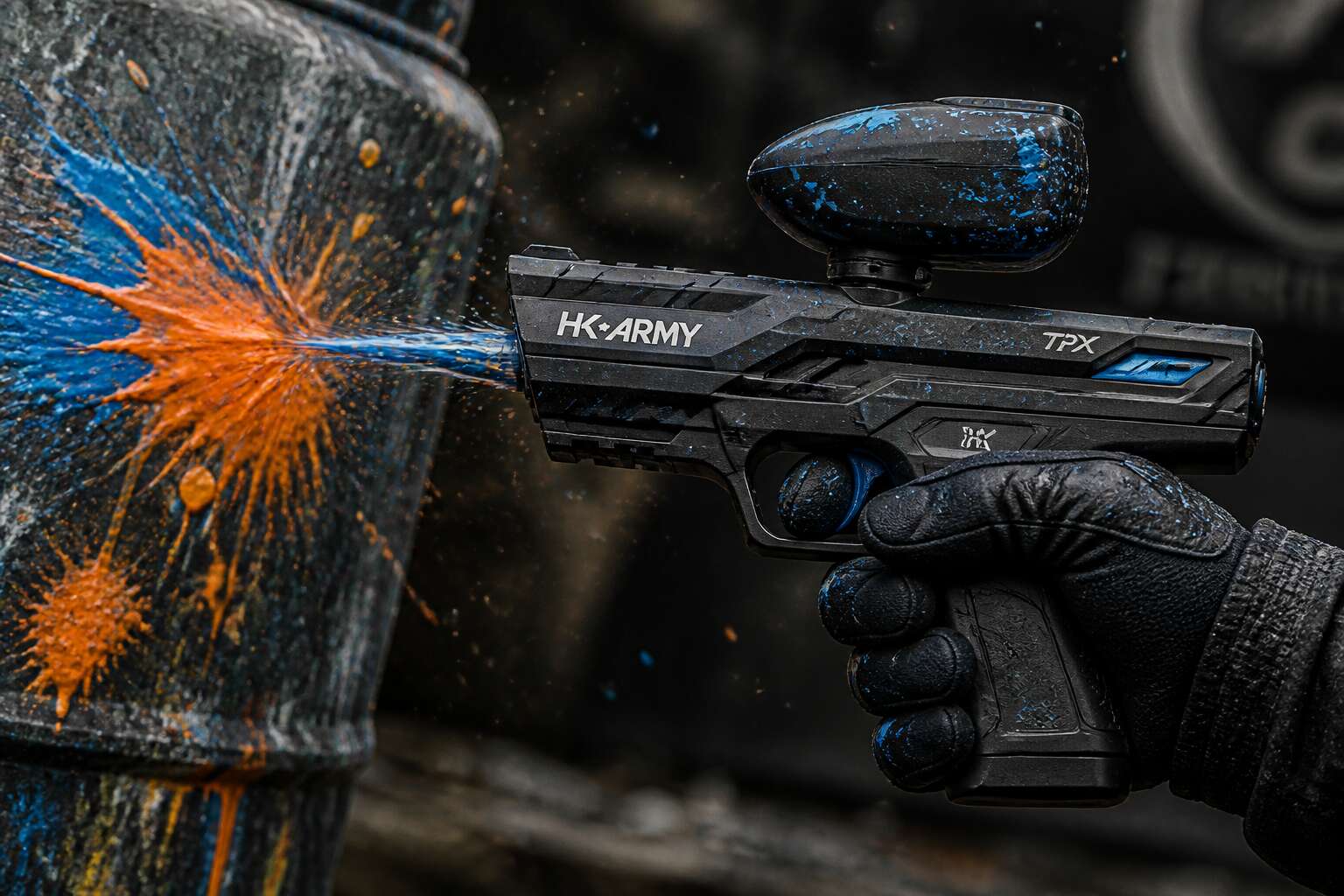
Tippmann’s compact line proves that a paintball pistol can carry the same fighting DNA as their full sized markers. The TiPX uses a 12 gram CO2 cartridge inside the grip, feeding from an eight round magazine. I have watched players dominate close quarters with this little beast. Its reputation rests on consistency, not just power. But you already know about power sources, so let’s talk money.
These pistols cost more than a rental grade marker, yet the build tolerances land in a different class. The metal sear and composite slide hold up under punishing use. For South African fields, where heat and dust kill cheap equipment, this matters. Many players buy one and never look back.
- A durable magazine release that works under gloves
- Easy disassembly for cleaning
- A grip that fits most holsters
Spend the extra rand. You will still be using this paintball pistol five years from now.
Umarex and the T4E Series
Umarex built its name on faithful firearm replicas, and the T4E series channels that precision into a paintball pistol that feels like the real thing. The T4E HDS and the TR50 use a 43 caliber round that strikes harder than a typical 68 caliber at close range. For South African owners who train for personal defense, this matters.
The trigger break on the TR50 is crisp. The muzzle flip is manageable. It feeds from an eight round magazine, and the CO2 cartridge sits inside the grip.
Consider the models:
– T4E TR50, a revolver style with a double action only pull
– T4E HDS, a polymer framed pistol with an optics rail
– T4E 68 caliber variants that pair with existing paintball gear
Each one carries the same build quality. You pay more, but you get a paintball pistol that behaves like a firearm, which is exactly the point.
Empire’s Sleek Designs
Empire approaches the paintball pistol with a sleek, low profile philosophy that sets it apart from bulkier tactical markers. Their design language favors clean lines, reduced surface area, and intuitive grip angles. That directly translates to faster target acquisition in close quarters, which South African players will appreciate immediately.
The balance is noticeable the moment you raise the marker! I have watched shooters swap heavier sidearms for an Empire frame after a single session. The compact profile reduces fatigue during extended training, and the barrel system holds accuracy despite the shorter length. It simply works with your natural stance.
What stands out across their lineup:
- Minimalist body construction
- Snag free contours for quick draws
- Modular rails for mounting lights or lasers
That combination of form and function explains why Empire remains a recommended brand for a practical paintball pistol.
High-End Custom Builds
For players who demand more from their sidearm, the market holds a few names that consistently deliver. Planet Eclipse and Dye offer factory paintball pistol models with regulated air systems and alloy frames. High end custom builds take this further. Gunsmiths in Johannesburg and Durban hand polish sears, recrown barrels, and adjust hammer springs for the local climate.
- Hand lapped barrels for consistent flight
- Dual O ring seals for gas efficiency
- Custom grips shaped to individual hands
These modifications turn a standard marker into a precise tool. The price stings, but for tournament players, the consistency is worth every rand!
Budget-Friendly Options
After you have priced a custom build, the factory range starts to look more sensible. Dye and Planet Eclipse still produce the most consistent paintball pistol models, but the price tag reflects that consistency. For many players, the extra expense becomes hard to justify.
Budget buyers have better choices today than a decade ago. Spyder and JT markers appear at local shops and online auctions for a fraction of the cost. They weigh more, and the air efficiency suffers, but they handle the basics reliably.
- Dye or Planet Eclipse for tournament pressure
- Spyder or JT for weekend play and practice
The purchase should reflect actual usage, because a paintball pistol that sits in a gear bag most of the season is a wasted investment.
Maintenance and Longevity
Cleaning the Barrel and Bolt
There is a particular kind of player who discards their paintball pistol after the weekend’s battle without a second thought. The rest of us know better. A barrel caked with paint residue and a bolt grinding through dried lubricant will turn the most refined marker into an unreliable companion.
Cleaning the barrel and bolt is a ritual, not a chore. Run a squeegee through the barrel after every session, then follow with a microfiber cloth to catch the stubborn film. The bolt demands equal attention. Remove it, wipe the old grease, and apply a thin layer of fresh oil. That is the entire secret.
- The attentive owner checks the o-rings for swelling or cracks each time.
- The lazy one stores the paintball pistol with the bolt bone dry, inviting corrosion.
Skip this routine and the first shot of the day will announce your neglect with a sputter. Keep it clean, and your paintball pistol will outlast every expectation you have of it.
Lubrication Best Practices
Roughly sixty percent of premature marker failures trace back to poor lubrication habits. For a paintball pistol, oil keeps the bolt cycling and preserves the o-rings. Choose a silicone based lubricant; petroleum products cause swelling and cracking over time.
Apply a single drop to the bolt and a thin film to the moving rails. Too much oil attracts dirt and creates an abrasive residue. The CO2 or HPA system demands different touch points.
- The valve pin and hammer need a friction check after each event.
- Reapplication happens after every 500 shots or when the action feels gritty.
The owner who understands these rhythms gets years of reliable service. The one who sprays and hopes gets a broken marker by winter.
O-Ring Replacement
Every paintball pistol relies on o-rings for internal pressure. These small elastomer loops seal the bolt, valve, and regulator. They soften, flatten, and crack with heat and friction. The manufacturer’s manual lists the correct sizes. A mismatched ring causes velocity swings and leaks. Owners in South Africa’s variable climate should inspect rings quarterly. Dry storage and direct sun accelerate degradation.
For an active paintball pistol, o-rings are a consumable. Common failure points include:
- the bolt guide
- the valve stem
- the regulator seat
Each one demands a specific durometer. Replacing them as a set prevents future downtime. A sluggish bolt or a hiss from the grip frame often means a ring has lost its shape. The average marker cycles hundreds of times per game day. That mechanical rhythm wears down even quality polyurethane. Spare o-rings weigh next to nothing, and the payoff shows during a long skirmish.
Storing Your Sidearm Properly
Storing a paintball pistol in a highveld garage during summer is a test of its materials. Heat and humidity find their way past the grip frame and into the trigger assembly! A cocked sear spring that sits compressed for months will lose its temper. Metal parts demand a dry environment. Consider these basics for a dormant marker:
- Degas the marker completely. Remove the CO2 capsule or HPA tank.
- Relax the mainspring by dry firing with a barrel sock.
- Keep a desiccant packet in the case.
The pistol resting on a concrete floor in a padded bag absorbs damp. Keeping it on a shelf, away from direct sunlight, and checking on it every few weeks preserves the action.
Troubleshooting Common Issues
Recalibrate your expectations. A paintball pistol endures brutal treatment, and the valve stem and sear surfaces wear in tandem. When one fails, the other follows swiftly. Velocity swings usually trace to a loose regulator or a compromised seal on the tank thread. Intermittent fire often stems from a bent hammer spring or a dirty detent in the magazine well of a paintball pistol. In South Africa, the dry Highveld air accelerates static buildup, which can confuse electronic trigger assemblies. The internal tolerances are tight. A paintball pistol left idle for months may develop a sticking striker, and abrasive dust from a dusty playing field will score the bolt rails. Longevity depends on catching these small failures early. A chronograph test reveals the truth. When the numbers wander, look for wear patterns on the hammer and valve seat.
Gameplay Tactics and Skill Building
One-Handed Shooting Fundamentals
In the heat of a South African bushveld skirmish, your paintball pistol becomes an extension of your will. One-handed shooting demands a disciplined grip and a steady breathing rhythm. I have seen players transform their accuracy by mastering the isosceles stance, even when a marker feels heavier than expected.
Focus on these fundamentals:
- Keep your wrist locked but your elbow slightly flexed.
- Align the barrel with your dominant eye.
- Press the trigger without jerking your whole arm.
Practicing weak hand only builds proprioception and control. This translates to quicker target acquisition during tight corridor play. Solo drills at short range develop muscle memory, so your paintball pistol behaves predictably when adrenaline surges. Over time, you find a rhythm that feels effortless.
Quick Draw and Reload Drills
In the bushveld, the difference between a hit and a miss often comes down to how fast your paintball pistol leaves its holster. Quick draw drills should start slow, focusing on a clean grip before speed. Repeat until the motion settles into your muscle memory.
- Start with your hand resting on the grip, then draw and fire at a target three meters away.
- Add movement, stepping sideways as you present the paintball pistol.
- Progress to firing from a low ready position after a sprint.
Reload drills deserve equal attention. A magazine change while your eyes stay on the opponent keeps you in the fight. Practice fumbling, because you will fumble under pressure. Short, sharp practice sessions build the kind of smooth efficiency that wins tight corridor battles. Keep the pistol close to your chest while swapping magazines, and your hands will learn the path without conscious thought.
Complementing Your Primary Marker
A paintball pistol changes your approach to a firefight because it changes your angles. When your primary marker runs dry, or the corridor narrows, the sidearm becomes the tool that lets you keep moving instead of retreating. That movement is what creates opportunities. A player who can transition smoothly keeps pressure on the opponent, forcing them to react rather than aim.
Skill building here means practicing the transition itself. Running drills where you switch from your marker to the paintball pistol while on the move trains your hands to find the grip without looking. The carry position matters too. If the holster sits too high or too low, the draw becomes a fumble under stress.
Consider these layers for tactical use:
- Position the pistol so it clears cover without exposing your torso
- Use it to suppress while your primary marker reloads
- Switch to it in tight spaces where a long barrel works against you
Situational awareness stays the real advantage. The paintball pistol covers close range, but only if you recognise when that range is closing. That recognition comes from playing often, reading the field, and trusting the sidearm enough to let it shape your decisions.
Close-Quarters Combat Strategies
In tight corners of a South African bushveld scenario or an indoor arena, the paintball pistol becomes your extension. I have seen players hesitate when the enemy closes to under five metres, because their primary marker feels cumbersome. That hesitation costs matches. The secret lies in constant movement and deliberate angle changes.
Use the pistol to keep your body low while snapping shots around barriers. Practice moving sideways while firing, since that confuses opponents tracking your silhouette. Also, train your off-hand to reload without breaking eye contact.
- Keep the pistol raised while advancing through doorways
- Fire twice, then shift position before returning fire
- Shoot from odd angles, like under a table or over your shoulder
When the range shrinks, your sidearm wins because it demands less space to manoeuvre. Trust your paintball pistol, and your close-quarters play will feel less like survival and more like control.
Accuracy and Aim Adjustments
Accuracy with a paintball pistol rarely comes from standing still. It comes from learning how your marker behaves while your body moves. I have watched players waste pods shooting high and left because they never adjusted for grip tension or eye dominance.
One drill that builds practical accuracy involves moving between cover and firing at a target the size of a dinner plate. You learn to align your sights before you stop moving, and you learn to correct your aim from the previous shot’s paint mark, not the wall splash.
If you study how your aim shifts between positions, a few patterns emerge:
- Kneeling removes lower-body sway, which tightens your initial grouping.
- The first shot’s paint mark tells you whether to adjust your barrel angle up or down.
- Comparing standing and kneeling groupings reveals how much your stance affects elevation.
The paintball pistol rewards players who read their own mistakes quickly.


0 Comments