
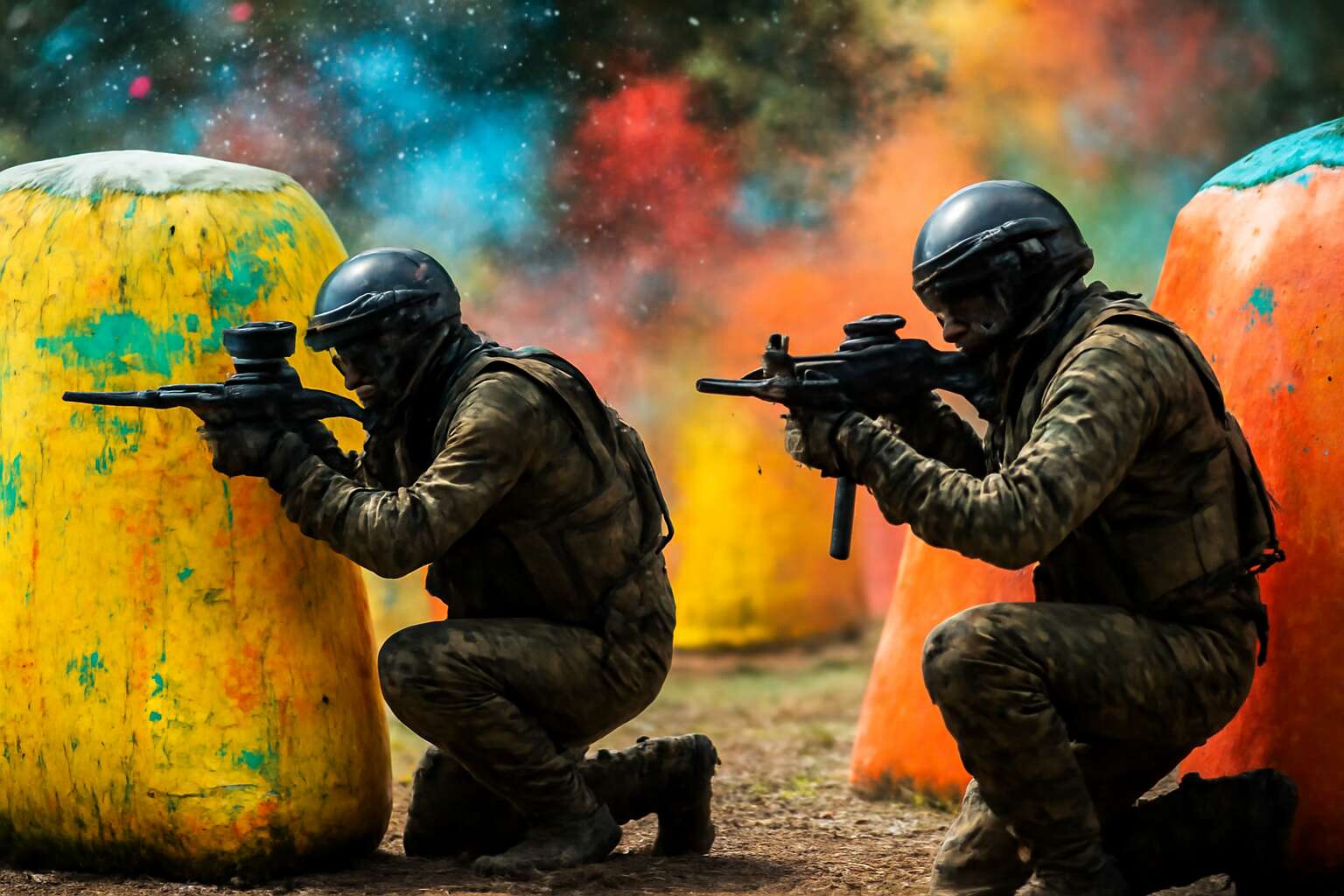
Key Range Differences Between Paintball and Airsoft
Effective range and accuracy benchmarks
On the field, the metric that matters isn’t swag but hit probability and how far it travels. The paintball vs airsoft range reality is a tug-of-war between heavy dye and light BBs. In controlled field conditions, paintball markers typically show an effective range of about 60 to 120 feet (18 to 37 meters), while airsoft rifles push toward 100 to 200 feet (30 to 60 meters). That translates into different tactics and bragging rights on South Africa’s rugged veld fields.
To keep the numbers honest, consider factors that shape accuracy:
- Consistency of velocity across shots
- Projectile weight and shape (paintballs vs BBs)
- Hop-up, barrel quality, and maintenance
These benchmarks aren’t gospel, merely yardsticks you’ll notice during games on SA fields—proof that the range is as much about your squad’s plan as the gun in your hands.
Projectile physics and hit perception
South Africa’s veld is a physics lab: paintballs hover at about 3 grams, chunky and splashy, while airsoft BBs run roughly 0.20 grams and cut through air with lean momentum. That mass-and-drag difference reshapes trajectories and how far they feel like they travel. This is the paintball vs airsoft range reality, not a bragging-rights metric—more a study in momentum, splash, and wind resistance on dusty SA fields.
Key physics and hit perception differences include the following:
- Mass and deformation: paintballs rupture on impact, delivering a visible mark; airsoft BBs stay intact, imprinting differently on surfaces.
- Spin and trajectory: airsoft commonly uses hop-up to impart backspin, broadening and stabilizing range; paintball markers don’t employ a comparable spin mechanism for range control.
- Impact feel and perception: paintball hits often crash with a crack and a splash of dye; airsoft hits are typically quieter but still register through gear and motion cues.
On SA fields, perception matters as much as velocity, and the line between reality and bravado is drawn by wind, cover, and how your squad reads the day’s tempo.
Marker and ammunition impact on range
On the South African veld, range isn’t a fixed number—it’s a living conversation between velocity, wind, and grit. I’ve learned to read the wind before loading. A shot travels farther when the air is calm, but a gust can bend a line like a fence in the wind.
Key differences show up in marker design and ammunition behavior. Understanding paintball vs airsoft range reveals how the heftier paintball shell loses energy quickly and drifts with wind, while the slender airsoft BB cuts through air with steadier momentum. That means the same marker can feel punchier one day and more limited the next, depending on weather and terrain.
Perception on SA fields matters as much as numbers; cover, dust, and squad tempo decide when a shot feels decisive. Your hit becomes a moment of truth, not bragging rights, and that’s the beauty of these games in the veld.
Field design influences on range performance
On the South African veld, range isn’t a fixed line but a dialogue between velocity, wind, and grit. Field design—the placement of cover, ridges, and open pockets—shapes how far a shot can travel before the air dampens it. A veteran likes to say, ‘range is the wind’s handwriting on the map.’
Key design elements that alter range performance include:
- Obstacle spacing and cover density
- Surface texture and bounce potential
- Visibility corridors and wind channels
Among enthusiasts, paintball vs airsoft range debates often hinge on how the field breathes. The same marker can feel expansive on a calm morning and tight when dust clouds rise, a reminder that numbers never tell the whole story of tempo and terrain.
Range Performance in Different Field Settings
Indoor versus outdoor range characteristics
Across South Africa’s arenas, space becomes a living myth where wind, light, and terrain improvise the rules. Indoor ranges compress action into crisp, predictable choreography, with walls narrowing sightlines and artificial lights carving clear silhouettes. Outdoor ranges unfurl to broader horizons, where sun angles, gusts, and uneven ground redraw the map of engagement. The paintball vs airsoft range dynamic here weaves atmosphere into accuracy.
- Indoor ranges: compact spaces, predictable lighting, tight corridors of action.
- Outdoor ranges: wind, sun glare, variable ground, and open sightlines.
- Hybrid settings: modular layouts that shift with seasons and terrain.
Inside, the rhythm is steady—controlled tempo, precise lines, and a discipline born of confinement. Outside, the tempo wanders with the weather, rewarding flexibility and terrain-reading.
From Cape Town to Bloemfontein, field settings invite players to dream in color and sound, turning range performance into a legend painted across a borderless map.
Engagement speed and distance across disciplines
In South Africa’s dusk-lit arenas, range performance wears a different crown with every field; paintball vs airsoft range reveals how engagement speed and distance braid with terrain, weather, and weapon discipline. The heavier paintball round lands with a defiant thump and a predictable arc, while airsoft BBs whisper along, inviting longer, subtler exchanges. Across disciplines, field settings sculpt tempo, turning a bold sprint into a measured stride or a patient crawl across open sightlines.
Consider the forces at play:
- Terrain and sightlines shape pace and range.
- Marker design sets cadence and engagement rhythm.
- Weather and wind redraw distances and arcs.
- Team reads translate field geometry into flow.
On South Africa’s varied fields, the saga of range performance persists as a study in atmosphere, momentum, and shade.
Cover, obstacles, and line of sight considerations
Range is a mood more than a measurement, and in South Africa’s dusk arenas the shadows do the arithmetic. Terrain, weather, and the time of day conspire to redefine how far a shot travels and how quickly engagements unfold.
Obstacles and cover rearrange the battle map. A low wall, a stack of pallets, or tufts of reed can dramatically alter visibility and the arc of a projectile.
- Natural screens: tall grass, scrub, dune crests
- Man-made barriers: pallets, barricades, crates
- Urban features: doorways, fences, corners
Line of sight, wind, and light flow across the field like weather in a market square. In South Africa’s varied terrains, the interplay between cover and exposure dictates tempo whether you’re playing paintball or airsoft. When you weigh paintball vs airsoft range, you notice the same field asking for patience, placement, and respect for the terrain.
Equipment and Ammunition Effects on Range
Marker types and velocity regulation
Equipment and ammunition shape the range in nuanced ways, especially when comparing paintball vs airsoft range. The marker’s design and the ammunition’s behavior determine exit velocity, consistency, and how material integrity holds up under field conditions. In South Africa’s vibrant arenas, velocity regulation remains the sentinel of safe, predictable play—as a veteran SA ref likes to murmur, “Speed is only half the story; accuracy is the other half”.
Key marker types and regulation approaches include:
- Chronography-based velocity caps tuned to field policy
- Gas systems (CO2 vs compressed air) affecting shot consistency
- Ammo quality and shape tolerance influencing range and bounce
In practice, velocity regulation and marker choice weave with environment and engagement style, shaping cross-discipline outcomes across SA arenas. I’ve watched officials calibrate a chrono between rounds to keep tempo humane. The shortest path to realism is seldom the straight line—it’s a balance of pieces and personalities.
Ammunition caliber, weight, and consistency
Across South Africa’s arenas, roughly 70% of engagements happen within 30 metres, where precision beats bravado. Equipment and ammunition shape range in subtle ways, especially when comparing paintball vs airsoft range. The marker’s design and the ammo’s behavior determine exit velocity, consistency, and how the gear copes under field conditions.
- Caliber and weight: paintballs are typically .68 cal (~3 g); airsoft BBs 6 mm, ~0.20–0.36 g—drives drop and drift.
- Shape tolerance and quality control influence stability and bounce, affecting the arc.
- Batch consistency matters; seams and QA quirks can introduce wobble beyond any chrono’s reach.
Gas systems—CO2 versus compressed air—shape shot-to-shot consistency, and chronography-based velocity caps keep SA field play humane. Ammunition quality and shape tolerance influence range and bounce, while wind and humidity prove the ultimate referees in paintball vs airsoft range.
Barrel quality and maintenance impact on range
Barrel integrity quietly determines how far the range actually feels in play. Barrel bore uniformity, finish wear, and liner life subtly modulate exit velocity and trajectory. In the paintball vs airsoft range conversation, tiny deviations compound under SA’s changing winds, turning a clean line into a wandering arc. The gas system—CO2 or compressed air—kisses the barrel differently, shaping shot-to-shot stability and the rhythm of the range.
- Bore quality and uniformity influence stability and the arc’s predictability
- Barrel wear and liner compatibility affect drop, drift, and bounce behavior
- Ammunition fit and gas pressure interplay shape velocity consistency across shots
Ultimately, barrel condition acts as a quiet gatekeeper in this range narrative.
Power sources and cycling stability
Power is the quiet referee of any arena, and the field its only witness. “Consistency is the art of turning chaos into rhythm,” as a veteran marshal likes to murmur. In SA fields, the right power setup can swing the arc of a game more surely than a painted target.
Equipment and ammunition shape how reliably a marker cycles and how stable each shot lands. CO2 surges with temperature, making older tanks temperamental; compressed air steadies pressure for a smoother feed and steadier cycling. In airsoft, battery voltage and gearbox efficiency matter as much as the gas line, while paintball’s tanks and regulators govern how the valve opens and closes under pressure. In the paintball vs airsoft range, power sourcing and cycling rhythm reveal themselves most clearly.
South African venues expose markers to sun and chill; the takeaway is your power and ammo choice will color every shot’s arc.
Tuning for optimum range and accuracy
Across SA ranges, the truth of range precision sits in the hardware, not luck. In local leagues, velocity variation tied to gear runs as high as 25%. Consistency, the whispered mantra of seasoned marshals, turns chaos into rhythm on the field!
Equipment and ammunition shape how reliably a marker cycles and how firmly a shot lands. CO2 expands with the sun, contracting when shadows fall; compressed air offers steadier breath to each feed. In paintball vs airsoft range, regulator stability and ammo consistency quietly govern the distance that follows the muzzle.
- Regulator output stability
- Ammunition consistency
- Feed and cycle reliability
As the field breathes with the rhythm of a shot, the tale is told by velocity spread, dwell consistency, and the quiet hum of the cycle. Equipment and ammunition set the scale of range, shaping how each encounter lands.
Safety, Maintenance, and Field Protocols
Safety standards and protective gear impact on range control
Across South Africa’s sunlit fields, a quiet calculation unfolds on the paintball vs airsoft range. The outcome hinges less on speed than on safety—the heartbeat of every game. On the paintball vs airsoft range, safety standards govern every engagement. Protective gear, from full-face masks to neck guards, isn’t optional flair; it’s range control in motion, shaping visibility, contact risk, and the tempo between rounds!
- Eye and face protection that meets local standards
- Head and neck protection for vulnerable zones
- Padding and coverings for exposed skin where impacts land
Maintenance keeps the field honest. I’ve seen how routine checks of masks, seals, and regulators—plus proper storage—preserve reliability and calm the arena’s pulse.
Field protocols bind it all. Briefings, marshal oversight, and velocity discipline shape every engagement. Safety standards and protective gear become the range’s control system, turning protection into performance on the field.
Maintenance routines to preserve range performance
In the paintball vs airsoft range, maintenance routines keep performance honest and the field alive with reliability. Regular inspections of masks, seals, regulators, and proper storage preserve reliability and calm the arena’s pulse. A well-kept field translates to predictable response times and safer play across South African ranges.
Maintenance touches gear, field fixtures, and environmental controls.
- Scheduled PPE inspections (masks, padding, straps)
- Seals, regulators, and air systems tested and refreshed
- Storage conditions to prevent corrosion and moisture damage
- Netting, barriers, and fixtures checked for wear
- Maintenance logs, calibrations, and incident records kept
Regular upkeep reinforces field protocols and keeps players focused on strategy rather than maintenance surprises.
Field protocols that affect distance control and fairness
Distance is the quiet umpire of the arena—deciding the rhythm of play in the paintball vs airsoft range! On South African fields, safety, visibility, and disciplined protocol keep the game fair while feeding the sense of wonder players chase in every scramble and standoff.
Safety governs distance at every turn. Proper PPE, clearly marked boundaries, and reliable velocity checks prevent overreach and surprise hits.
- Mask integrity, padding, and strap checks
- Boundary markers and clear ceasefire signals
- Consistent comms and hand signals to request disengagement
Maintenance and field protocol bind distance control to reliability. Regular reviews of nets, lighting, and fixtures, plus logs of calibrations and incidents, create predictable engagement envelopes across sessions and ensure fair play endures.
Calibration and field rule enforcement
Safety isn’t a side note; it’s the trigger that keeps teams level and bruises minimal. On the paintball vs airsoft range on South Africa’s fields, proper PPE, consistency in velocity checks, and clearly marked boundaries keep the action fair and the players upright while the drama unfolds in a controlled ballet.
Maintenance and field calibration bind distance discipline to reliability. Regular reviews of nets, lighting, and fixtures, plus logs of calibrations and incidents, create predictable engagement envelopes across sessions and ensure fair play endures.
- Velocity checks and chronograph records
- Boundary integrity and ceasefire signal verification
- Incident logs and calibration histories
Field rule enforcement follows the same cadence: clear comms, ritual disengagement signals, and a fair-decision process that stays consistent from first shot to last. It’s the quiet referee that keeps the arena honest—and safe for everyone!
0 Comments