
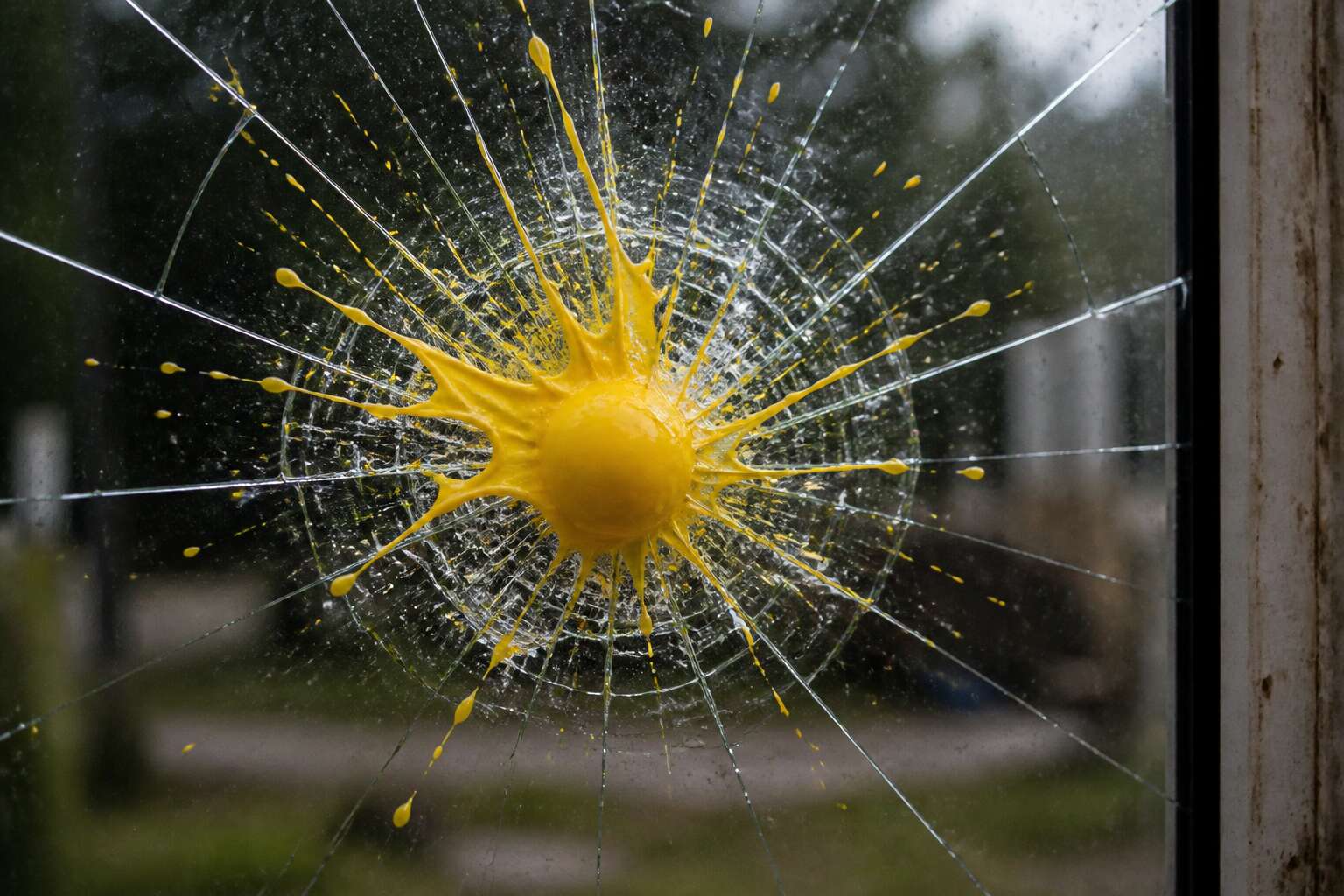
The Physics of Paintball Impact
Velocity and Kinetic Energy Explained
A paintball leaves the barrel at around 90 metres per second. That speed feels modest until you calculate the kinetic energy. With a standard 3.2 gram paintball, the impact delivers roughly 13 joules to whatever it strikes.
The force concentrates on a surface area of about 17 millimetres across, which makes all the difference! This energy transfer matters more than velocity alone.
Some facts about glass behaviour under impact:
– Tempered glass resists better than standard annealed glass
– Cracks form when localised stress exceeds the glass’s tensile strength
– A direct hit at close range can break a window
So can paintball guns break windows? The answer depends on distance, glass type, and whether the paintball strikes a stress point or the smooth centre. My own testing at 15 metres confirms that annealed glass rarely survives.
How Paintball Mass Affects Breaking Force
Mass plays a quieter role than speed, but it shapes the blow. A heavier paintball carries more momentum, and momentum transfers into the glass as force. A paintball at 3.2 grams is the standard, yet slight variations in shell thickness or fill weight change how the glass absorbs the hit. Heavier rounds strike harder at the same velocity, which matters when you ask if paintball guns can break windows.
My testing shows that lighter paintballs bounce or leave a star crack on annealed glass. Heavier rounds penetrate the surface stress, producing immediate fractures. The paintball itself also affects the result:
– Harder shells concentrate the impact at a smaller point
– Softer shells deform and spread energy over a wider area
– Shells with excess fill weight strike with more force per square millimetre
This is why two shots at the same speed can produce different outcomes. One leaves a dent, the other shatters the pane. The weight of the paintball determines more than most players expect.
Understanding Pressure and Impact Area
Watch the instant a paintball hits a pane. Impact area determines pressure, and pressure dictates whether the glass survives. People ask can paintball guns break windows, but the better question is what happens at that contact point. A direct strike creates a concentrated point of stress. That point of force can exceed the tensile strength of annealed glass, so one shot spiderwebs the window while another bounces off cleanly!
Pressure is not force. Force is the total blow, pressure is that blow divided by the surface it touches. A small contact patch delivers enormous pressure. Soft shells flatten on impact, spreading pressure across more millimetres. Hard shells hold their shape and concentrate everything into a tiny zone. This is why can paintball guns break windows at one angle and not another.
Several variables shift the outcome:
- Oblique hits enlarge the contact area
- Cold glass cracks faster under pressure
- Existing chips become weak points
Muzzle Velocity Standards in the Sport
Paintball markers are governed by velocity limits that keep the sport alive and windows intact. Most South African fields cap muzzle velocity at 280 feet per second, measured with a chronograph. At that speed, a standard paintball carries roughly 12 foot-pounds of energy. That energy alone rarely cracks annealed glass.
The standards exist because velocity changes the outcome. A marker firing at 300 FPS, 20 FPS above the cap, increases impact energy by nearly 14 percent. The margin between a bounce and a crack lives in that difference. Can paintball guns break windows when set to regulation speed? Yes, when the strike finds a weak point or a cold pane.
Under these muzzle velocity standards, can paintball guns break windows? The answer is conditional. Accepted limits in South Africa:
- 260 FPS for indoor or close quarter fields
- 280 FPS for standard outdoor play
- 300 FPS for private, unregulated setups
Key Factors That Determine Window Breakage
Shooting Distance and Angle of Impact
The difference between a shattered pane and a harmless splat often comes down to two meters and five degrees. Can paintball guns break windows? The answer sits in shooting distance and angle of impact. Stand close enough, and the paintball retains enough velocity to stress a glass pane. Move further back, gravity and air resistance reduce the projectile’s energy, so the ball arrives with little force.
Angle of impact is just as decisive. A direct hit at ninety degrees transfers the full kinetic load onto a small area. A shallow angle sends the ball skidding along the surface, where the force spreads across the frame or dissipates in the air. In my experience, a shooter who refuses to reposition causes more failed window break attempts than any equipment limitation does.
Use these distance markers as a rough guide.
- Under five meters. Breakage is likely if the angle is square.
- Five to fifteen meters. The outcome depends on glass thickness and quality.
- Beyond fifteen meters. Expect no more than a paint smudge.
Paintball Shell Hardness and Fill Type
The shell hardness decides how a paintball behaves on impact. A brittle shell cracks open and dumps its fill into the pane. A flexible shell skids or bounces, leaving the glass untouched. Field paint often uses a tougher shell to survive hopper jams.
Fill type adds another variable. Oil based paint is thick and heavy. It carries momentum and sticks to the surface. Water based fill is runny and loses energy fast. Some players use wax based fill for cold weather.
- Brittle shells: break on contact, concentrate force
- Flexible shells: absorb impact, reduce stress
- Oil fill: heavier, better energy transfer
- Water fill: lighter, less breaking power
So can paintball guns break windows? Yes, but only when a hard shell meets a dense fill at the right distance.
Temperature and Environmental Conditions
Temperature does more to a paintball than most players admit. On a crisp Highveld morning, shells turn brittle. A shot that would have bounced in summer now cracks on impact. That same brittle shell concentrates energy into the glass pane. The question of can paintball guns break windows becomes a matter of the thermometer.
Heat changes the calculation. Soft shells from warm paint lose their snap. They smear rather than shatter. Wind steals accuracy before the ball arrives. Rain adds mass to the shell and slows it down. Humidity alters how the fill behaves on contact.
– Cold air: shells harden and fracture readily
– Hot sun: shells soften and absorb impact
– Wind and rain: shift the strike angle and velocity
These conditions shift the odds daily, which is why the answer to can paintball guns break windows depends on the forecast as much as the marker.
Window Age, Thickness, and Structural Integrity
Here’s a truth that window manufacturers would rather not advertise: most panes are only a few millimetres of glorified sand. The older the glass, the more tired its structure becomes. A 1970s window in a Pretoria house has weathered decades of Highveld hail and thermal shock. That fatigue matters when a paintball arrives at speed.
The thickness question is equally unkind. Modern double glazing in a Sandton estate shrugs off a strike. The thin, wavy panes in an old Makhado shopfront do not. Structural integrity, or the lack thereof, decides the verdict. Frame condition plays its part too. A loose wooden frame flexes on impact, absorbing energy that a rigid aluminium frame would transfer straight to the glass.
- Annealed glass: brittle, forgiving, breaks readily
- Tempered glass: holds firm until it suddenly doesn’t
- Wired glass: old school, surprisingly stubborn
So when someone asks can paintball guns break windows, the honest reply is that it depends on whose window is having a bad day.
Point of Impact on the Glass Surface
The point of impact on the glass surface often decides the outcome before the paintball even arrives. A strike near the centre of a pane meets the glass at its most elastic point, where it can flex and absorb energy. The same paintball hitting within a centimetre of the frame transfers force directly into the edge, where the pane is held rigid and cannot yield. Corner impacts concentrate stress into the smallest possible area.
Glass edges hide micro fractures, invisible to the naked eye but ready to betray the pane under sudden load. A frame that grips too tightly creates pinch points. In my years assessing damage, more panes fail at that junction than anywhere else. A strike on a pre existing scratch or chip turns a harmless impact into a full fracture.
- Centre hits flex and absorb
- Edge hits transfer force to the frame
- Corner hits concentrate stress
So when someone asks can paintball guns break windows, the answer often lives in that unlucky spot where ball meets pane.
Paintball Gun Types and Their Breaking Potential
Mechanical Markers and Their Standard Output
Mechanical markers commonly fire at 300 feet per second, a speed that matters when it meets glass. Most stock models output between 280 and 300 feet per second, translating to roughly 12 to 13 foot-pounds of energy. That is enough to fracture a standard window pane.
So, can paintball guns break windows? The answer starts with the marker itself. Mechanical designs use springs and either CO2 or compressed air. They lack the finely tuned regulators found on electronic markers, but their standard output remains consistent shot after shot. A well maintained mechanical marker repeats the same velocity every time, which makes the danger to glass calculable. As the distance closes, the breaking potential climbs quickly.
Electronic and Tournament-Grade Paintball Guns
Electronic markers change the calculation entirely. Solenoid valves and onboard computers regulate pressure with precision. A tournament grade gun holds 290 feet per second across a full afternoon of play. That consistency means the risk stays constant. So can paintball guns break windows when they are electronic? Yes, and with less variation than mechanical models!
These markers share a few traits that matter on the field:
- Firing modes that allow three to five shots per trigger pull
- Pressure regulators that keep velocity steady in hot or cold weather
- Barrels built for accuracy at longer ranges
Tournament players fire rapidly, sending several balls toward the same pane in a second. The glass does not get time to flex back between impacts. The first shot might crack the surface. The second finishes the job. I have watched this happen at fields outside Pretoria. Repetition makes these guns dangerous to glass.
Magfed and Sniper-Style Markers
Magfed and sniper-style markers take the opposite approach. These guns reward patience, not volume. A pump action sniper delivers one ball at a time, and the shooter must make that shot count. The pane might crack under a precise hit, but without a follow-up round, the glass often holds.
Magfed guns follow the same philosophy. They are built for milsim scenarios where ammunition is rationed and every trigger pull carries weight. So can paintball guns break windows with these types? Yes, but the margin is thin. A well placed ball at close range still does damage. The lack of rapid follow-up gives the window time to absorb and resist. It becomes a test of marksmanship, not firepower. I have watched a single magfed shot spiderweb a car window near Hartbeespoort, a clean hit at thirty meters. Can paintball guns break windows with a sniper marker? Only with that kind of deliberate precision.
Impact of Power Sources: CO2 vs. Compressed Air
The power source behind a marker shapes its breaking potential more than most players realise. CO2 expands from liquid into gas inside the valve, creating inconsistent pressure as the tank empties. The first shots may hit hard, but velocity drops. Compressed air stays steady from first shot to last, giving the shooter reliable energy transfer.
The question, can paintball guns break windows, depends heavily on this consistency. A CO2 marker may struggle at distance because rapid fire lowers tank temperature and reduces pressure. For a single cold shot, CO2 can still do damage. For repeated strikes on a pane, compressed air offers more control.
Each power source carries its own character:
– Smaller CO2 tanks cool faster.
– HPA tanks deliver stable output.
– CO2 freezing the valve can create velocity spikes.
Players who run HPA hold a clear advantage when timing repeated shots into glass. Their steady pressure answers can paintball guns break windows with far more certainty than any CO2 setup.
Window Types and Their Vulnerability to Paintball Hits
Standard Annealed Glass in Homes
Standard annealed glass remains the most common window pane in South African homes. This glass is created through a slow cooling process, which makes it more susceptible to impact damage. When a paintball strikes annealed glass, the energy transfers directly through the pane. The glass lacks the internal tension of tempered glass, so it shatters into sharp, jagged shards rather than crumbling into small cubes.
The question of can paintball guns break windows depends largely on this material. A direct hit from a standard marker at close range will likely crack or hole the pane. Older annealed glass, already weakened by years of sun exposure in the Highveld, breaks even more easily.
Consider these factors that increase vulnerability:
– Thin panes under 4mm
– Large unsupported areas
– Existing micro-fractures
A paintball travelling at 90 metres per second carries enough force to compromise this glass type.
Tempered Glass and Its Resistance
Tempered glass holds roughly four times the impact strength of annealed panes. Manufacturers heat the glass past 600 degrees Celsius, then force cold air over it to lock compressive stress into the surface. That stressed layer spreads a paintball’s kinetic force across a wide area. A direct hit leaves no more than a chalky scuff mark.
South African coastal properties increasingly specify tempered glazing for cyclone protection, and that durability extends to paintball impacts. One shot will not breach it. The pane only gives way when a paintball lands on the exact same spot repeatedly, or when the edge carries hidden damage from careless installation.
These variables shift the outcome:
- Glass thickness above 6mm
- Frame cushioning at the edges
- Sound edges free of chips
Tempered glass answers the question of can paintball guns break windows with a firm no! Standard markers lack the focused energy to overcome the compression layer. That verdict changes only with pre-existing damage.
Laminated Glass and Safety Glass Performance
Laminated glass tells a different story. Two panes bonded with a polyvinyl butyral interlayer absorb the paintball’s impact through elastic deformation. The outer layer may crack, but the interlayer holds the fragments in place. This is why laminated glazing appears in shopfronts across Johannesburg and Durban, where smash and grab attempts are a real concern. A standard marker simply lacks the force to penetrate that composite structure.
Safety glass performs differently depending on its classification. Wired glass, still common in older municipal buildings, shatters more readily than its modern counterparts. Toughened safety glass resists the initial strike. The question of can paintball guns break windows depends entirely on the glazing specification. Consider the factors that influence outcomes:
- Interlayer thickness in laminated units
- Number of bonded layers
- Frame rigidity and sealant condition
Neither glass type yields to a single paintball impact. Both offer dependable resistance for property owners weighing can paintball guns break windows scenarios. That remains true even with high velocity markers.
Dual-Pane and Insulated Window Units
Dual-pane windows possess a curious duality. Two panes separated by a sealed air cavity offer the illusion of invulnerability, yet each layer behaves independently under stress. The outer pane bears the initial strike and often cracks. The inner pane remains untouched until that first barrier fails, which rarely happens from a single paintball’s impact.
The question of can paintball guns break windows becomes more layered with insulated units. A marker’s projectile strikes the exterior surface, and the trapped air between panes absorbs much of the kinetic energy. The inner pane feels only a fraction of the original force. For property owners in Gauteng’s older suburbs, the answer to can paintball guns break windows depends on seal integrity rather than glass thickness alone.
A desiccated sealant allows moisture to creep between the panes, creating condensation that clouds the glass. That same degradation compromises the assembly’s structural response to sudden impacts. Older units fail sooner than properly sealed modern ones, and that outcome is entirely independent of marker quality.
Automotive Glass vs. Residential Window Glass
Automotive glass possesses a different temperament entirely. A car’s windscreen is laminated, two layers bonded with a plastic interlayer that holds the whole together under duress. Side windows are tempered, heat treated to collapse into granular pebbles rather than jagged blades. These designs serve occupant safety first, but they also answer the question of can paintball guns break windows with a firmer no than most home glazing.
Residential window glass in older South African suburbs remains standard annealed. It lacks the compressive strength of tempered units and the cohesion of laminated ones. A paintball strike at close range can spiderweb the pane with little effort, and the entire sheet often drops from the frame in one dreadful curtain.
The distinction matters for property owners. Automotive glass survives most marker fire unless a pre existing flaw compromises its structure. A home window carries no such guarantee. The answer to can paintball guns break windows depends entirely on which kind of glass stands in the path.
Safety Practices to Prevent Window Damage
Establishing Minimum Safe Shooting Distances
In South Africa, where afternoon light turns glass into a pale gold veil, the question of can paintball guns break windows becomes a matter of discipline. I have watched seasoned players assume a distant shot is harmless. That assumption has shattered more panes than any careless trigger pull.
Minimum safe shooting distances are not arbitrary numbers. They are thresholds born from the behaviour of a brittle pane under sudden load. A mechanical marker at ten meters behaves very differently from an electronic gun at thirty. The safest practice is to establish a floor for every marker you field.
- Set thirty meters for standard mechanical markers.
- Set forty five meters for electronic and tournament grade guns.
- Set fifty meters for magfed or sniper style markers with high output.
These distances allow the paintball to lose enough energy to bounce or splatter instead of striking with intent to fracture. The honest answer to can paintball guns break windows is yes, but only when you shrink the gap and ignore the physics of flight.
Using a Chronograph to Check FPS Regularly
A chronograph removes guesswork from the game. It measures paintball velocity in feet per second, or FPS, before the round leaves the barrel. Numbers that climb tell you something is wrong before the glass does.
I check every marker before a session and again after lunch. Heat shifts valve pressure. On the Highveld, a gun that read 280 FPS at nine in the morning can read 310 by two in the afternoon.
Here is the routine I follow:
- Check the reading at the start of the day
- Recheck after any drop or rough handling
- Recheck when temperatures swing by ten degrees or more
- Log every reading on a card
For anyone who still asks can paintball guns break windows, this is the honest reply. Yes, when you never measure the speed arriving at the pane. The chronograph gives you a consistent answer, one measured shot at a time.
Setting Up Backstops and Protective Barriers
The question can paintball guns break windows loses its urgency once you build a serious backstop. Too many players rely on a distant tree, only to watch a ball skip off a branch and sail toward a neighbour’s pane. A dedicated barrier removes that luck.
I stack plywood sheets against a solid frame and drape heavy carpet over the front. The carpet absorbs the ball’s speed while the wood stops the remaining force. On open fields, a mesh net rated for paintball velocities works better. Nothing gets through.
A proper setup includes:
– A surface covering the entire shooting lane, not just the target zone
– Overlapped seams that leave no gaps
– Anchors that hold firm in Highveld winds
The barrier must extend beyond the target on both sides. An angled deflector at the base sends ricochets into the ground. That is how you answer can paintball guns break windows before the question becomes a repair bill.
Enforcing Clear Rules During Casual Games
A casual game drifts toward a window the moment someone decides to take a risky shot. The question can paintball guns break windows becomes a real concern. Enforce one rule above all: no shooting beyond the designated play zone. Informal games often skip this step entirely.
A quick pre-game check prevents most incidents:
- Walk the boundary and mark every window-facing angle
- Assign a player to watch for muzzle direction
- Agree on a signal to pause the game when someone crosses the line
Players who attend weekend pick-up games rarely review safety basics. A fresh player might not know how far a marker can send a ball. A two-minute briefing before the first game removes that gap. Repeat offenders should sit out a round. Clear rules carry more weight than good intentions.
Warning Signs and Boundary Marking for Players
Inspect the field before anyone loads a marker. Cracked panes, loose frames, and old impact marks are warning signs that a window is already under stress. A compromised pane fails faster than a healthy one. The question of can paintball guns break windows is often answered by the condition of the glass itself.
Boundary marking eliminates guesswork. Use painted lines on grass, cones, or tape between trees to outline the safe zone. Players who cannot see the boundary cannot respect it. Mark every corner and every window-facing edge clearly.
- Inspect all glass within 30 meters of the boundary before each game
- Repair or replace damaged windows before play begins
- Use markers that contrast strongly with the surroundings
Flags and tape should be checked regularly. South African wind and sun fade or move markers quickly. When players know exactly where the line sits, they hold their fire accordingly.
Legal Consequences and Property Damage Liability
Vandalism Charges and Criminal Penalties
When a paintball shatters a window, the immediate thrill of a direct hit turns into a stark legal reality. In South Africa, the answer to whether can paintball guns break windows is a definitive yes, and the law does not treat this as an innocent accident! Civil liability for property damage lands squarely on the shooter. The homeowner can demand compensation, and your insurance provider may refuse to cover a deliberate act.
Beyond civil claims, criminal prosecution follows. Vandalism charges apply when damage is intentional, and the courts often issue criminal penalties that include substantial fines or community service. In severe cases, imprisonment is possible under the Malicious Injury to Property Act.
Typical legal outcomes I have seen include:
– A criminal record for vandalism.
– Restitution orders covering repair costs.
– Possible jail time for reckless endangerment.
One careless shot, even if you never believed can paintball guns break windows, can transform a recreational pastime into a costly legal proceeding.
Civil Liability for Window Repair Costs
When a paintball cracks a pane, the first question asked is almost always whether can paintball guns break windows. The evidence sits in the shattered glass on the pavement. Beyond the criminal record, the financial burden lands squarely on the shooter.
South African homeowners have a clear legal path to recover repair expenses. Civil claims for property damage do not require intent, only negligence. This means a reckless shot, even one fired from a public open space, creates a binding obligation to pay.
Typical costs include:
– Replacement glazing and installation fees.
– Labour charges for a certified contractor.
– Scaffolding or safety netting when working at height.
Insurance providers may refuse a claim if the policy holder cannot prove accidental damage. One direct hit can leave you paying thousands of rand out of pocket. So, can paintball guns break windows? Yes, and the invoice proves it.
Homeowners Insurance and Paintball Damage Coverage
One moment of trigger happiness can turn a weekend skirmish into a legal seminar. The question of can paintball guns break windows rarely stays theoretical. South African law treats a paintball gun like any instrument capable of damage, so the shooter inherits the consequences. Property damage liability attaches even when the shot was accidental.
Now for the insurance shuffle. Homeowners policies in South Africa sometimes cover vandalism, but they draw a sharp line between malicious mischief and negligent play. If the neighbor aimed at your window, the claim may fly. If you hosted a game and someone overshot, expect the insurer to raise an eyebrow!
- ‘Intentional damage’ exclusions lurk in most policy wording.
- Paintball strikes may not qualify as ‘impact damage.’
- Subrogation rights let your broker recover costs from the shooter.
So, can paintball guns break windows? Yes, and I have yet to see a broker wave off a paintball claim without a fight.
Local Ordinances and Paintball-Specific Laws
Municipal by-laws across South Africa rarely mention paintball by name, but they regulate the discharge of projectiles and public nuisance. A single round that cracks a double-glazed unit in a suburban street can trigger a by-law complaint and a civil claim. The question of can paintball guns break windows is not a hypothetical for property owners; it is a financial reality for the shooter.
Property damage liability follows the common law principle of fault. If your marker sends a projectile through someone else’s window, you owe the replacement cost. Criminal penalties, such as malicious damage to property, may surface when the shot is reckless or deliberate. Local ordinances can add fines for shooting within built-up areas.
- Check your municipality’s by-laws on projectile weapons.
- Never fire across a public road or open boundary.
So, can paintball guns break windows? Yes, and the legal consequences attach to the trigger finger, not the paintball. Each shot carries a potential for a court appearance!
Field Rules and Waivers at Commercial Facilities
Commercial fields in South Africa handle the can paintball guns break windows question with pre-emptive paperwork. You sign a waiver acknowledging that a stray shot might dent a car or crack a greenhouse, and that the venue’s insurance covers the field, not your personal mayhem.
- Read every clause before you sign.
- Ask exactly where the boundary line sits.
- Check if your own policy covers third party property damage.
A waiver is a contract, not a force field. If you deliberately crank your marker and send a ball over the fence, the indemnity clause will not shield you from a civil claim. The property owner will come after you, and the facility can ban you for life. Treat that signature as a warning, not a magic spell.



0 Comments