
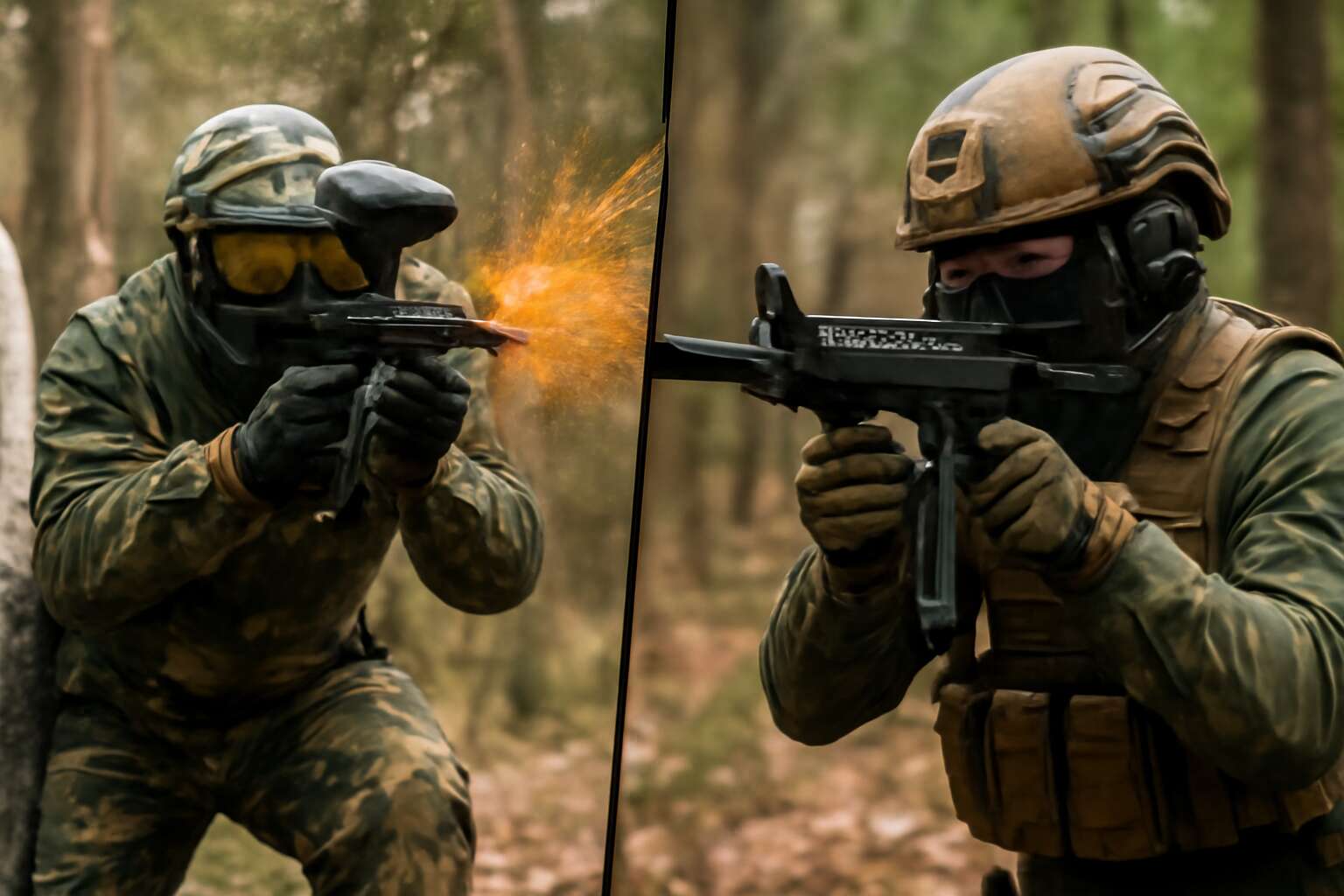
Key factors that influence difficulty in paintball vs airsoft
Physical demands and stamina in competitive play
In South Africa’s bustling paintball and airsoft scenes, cardio is the silent referee—relentless and decisive. A veteran SA coach once quipped, “Cardio doesn’t bluff; the heart tells the truth on game day.” That truth shapes the way players approach rounds and the tempo I feel in my own legs when fatigue pools around my boots.
Key factors hinge on endurance, terrain, and gear weight. The veld and arena dust demand quick changes of pace, lower stances, and precise breathing under pressure. To illustrate the rhythm, consider these:
- Terrain and footing across sand, grass, and hard stands
- Gear weight and mobility in close-quarters engagement
- Recovery between bursts and cognitive clarity under adrenaline
So, which is harder paintball or airsoft? The answer isn’t monolithic; both push stamina, mental focus, and tactical pacing to the edge. The heavier strain comes from sustained sprinting, rapid decisions, and heat management in SA’s sun-baked fields.
Skill development and learning curve
Across South Africa’s paintball and airsoft fields, skill development unfolds with quiet intensity. A veteran SA coach says, “Skill compounds while luck fades on game day.” Players feel the difference as they move from instinct to plan, and the learning curve becomes the battleground.
Airsoft rewards precision, breath control, and patience; paintball prizes rapid decisions under heavier gear. The curve hinges on feedback: adjusting stance, trigger rhythm, and cover. The cognitive load of reading positions while staying safe matters as well.
- Stance, exposure, and movement through cover
- Trigger control, breathing, and shot discipline
- Situational awareness and clear communication
- Gear maintenance and reload discipline
Ultimately, which is harder paintball or airsoft? The verdict rests on skill development rather than gear.
Safety rules, PPE, and gear complexity
Safety rules aren’t speed bumps; they’re the spine of any SA field. When PPE is mandatory and hit zones are enforced, play grows complex fast. In the debate over which is harder paintball or airsoft: safety gear becomes the quiet referee, dictating pace and caution.
PPE demands differ but share a safety gospel. A standard SA field requires a full-face mask, reliable eye protection, and sturdy gloves. Airsoft relies on lighter goggles; paintballers lean into rugged masks built for velocity.
- Full-face mask with anti-fog and ventilation
- Impact-rated eye protection and a secure seal
- Padded gloves and elbow/knee protection
- Breathable jerseys and cooling solutions
Gear complexity also matters: reloading discipline, battery checks, loader maintenance, and on-field tweaks. Paintball’s CO2 or compressed-air rigs and bulk hoppers contrast with airsoft’s battery-powered platforms and hop-up adjustments, shaping the difficulty curve for SA players.
Entry barriers and accessibility for beginners
In South Africa’s dusk-lit fields, beginners drift toward airsoft like moths to a neon flame, while paintball demands a heavier toll in time and gear. A recent survey from SA venues hints that first-timers outnumber seasoned players two to one in airsoft, drawn by speed and concealment more than bulk and bang. This divergence shapes entry barriers as the first quiet duel between sport and novice.
Which is harder paintball or airsoft is not just about aim but about access. The hurdles are tangible: equipment costs, field availability, rental quality, and age or safety rules that can keep a curious mind at the gate.
- Cost of gear and ammo
- Field proximity and opening hours
- Rental and initiation options
- Age restrictions and safety mandates
Yet for many, the promise of a shadow-draped arena draws them forward into the unknown.
In-game mechanics and how they shape challenge
Projectile physics and hit feedback
In exploring which is harder paintball or airsoft, players discover that the battlefield is less a stage and more a living equation where in-game mechanics tug at your nerves. Velocity whispers, angles bend, and the mind learns to anticipate recoil, wind, and timing with a poet’s patience.
Projectile physics and hit feedback become the true sculptors of difficulty. The crack of a marker, the whisper of a ricochet, and the feel through gear translate into a tactile map you read in real time.
- Projectile arc and drop over distances
- Wind drift and gear weight affecting aim
- Hit feedback latency shaping decision pauses
In South African arenas—from dusty training yards to tight urban corridors—these dynamics test your perception as keenly as your trigger discipline, shaping which is harder paintball or airsoft into a question of environment and execution rather than sheer speed.
Accuracy, sighting, and aiming challenges
On a South African dusk, precision becomes poetry. “Sighting is the real duel,” a veteran tactician once quipped, and the question which is harder paintball or airsoft hinges on how you read distance, wind, and timing rather than sheer speed.
In-game mechanics shape challenges to accuracy, sighting, and aiming. Optics—iron sights, red dots, or holographic sights—change your sight picture and require micro-adjustments under pressure. Trigger consistency, shot ramp-up, and marker feedback translate into a mental reticle you refine while moving.
Key in-game mechanics that influence accuracy include:
- Sighting options and optic integration
- Trigger pull consistency and fire control
- Velocity management and feedback latency
- Aiming under fatigue and movement
In South Africa’s diverse arenas—from scorching dust bowls to tight urban lanes—wind and debris test your sight picture and timing, reminding players that the challenge is environment as much as equipment.
Elimination rules, respawns, and match duration
Game tempo breathes life into every shot. When you ask which is harder paintball or airsoft, you’re not just weighing projectiles—you’re testing the spine of the round: elimination rules that cannot be negotiated and the clock that never slows. In this arena, in-game mechanics sculpt the challenge more than sheer speed.
Elimination rules seal fate in real time. No respawns compress the battlefield into a single gravity pull where one mistake hangs like a neon target. With respawns, the pressure eases yet extends the match, shifting the rhythm and sharpening decision-making under fatigue.
- Elimination rules drive risk-reward decisions
- Respawn mechanics reset the pressure and pacing
- Match duration creates a final cadence to the rounds
Across South Africa’s varied venues, the echo of timers and the breath in the lungs become the same variable. That answer—which is harder paintball or airsoft—depends on how long you can hold focus as rounds churn and the field narrows.
Field layout and cover utilization
Under the pale lamp of the arena, in-game mechanics become a shadowed compass. The question which is harder paintball or airsoft lands not in hardware but in the field itself, where sightlines carve fate and terrain dictates tempo. In South Africa’s dusty fields and urban wreckage, cover and geometry twist the challenge into a map of breaths, not bullets—a theatre where every pop of paint writes a new route.
- Dense cover creates shadow lanes that reward timing over raw speed
- Open areas force patient pacing and careful angles
- Vertical elements turn the field into a layered battlefield with multiple attack vectors
Field layout and cover utilization become the pulse of the encounter, shaping risk and retreat as players breathe with the same rhythm that marks every heartbeat.
Equipment considerations and maintenance impact on difficulty
Weapons platforms and reliability
Across South Africa’s urban arenas and open fields, the hardware you trust can outpace your reflexes. The debate surrounding which is harder paintball or airsoft often hinges on gear reliability as much as skill. Equipment considerations and maintenance dramatically shape the difficulty: a capricious marker or jumbled hop-up can erase momentum faster than a missed shot. Different weapon platforms demand different upkeep; their reliability under dust, humidity, and field abuse becomes a quiet, relentless judge of a player’s tempo.
- Seals, O-rings, and gas systems kept clean and lubricated
- Battery health, terminals, and electrical contacts checked
- Magazine, feeder, and feed tube reliability tested
- Barrel cleaning and hop-up or velocity checks where applicable
Protection, masks, and comfort
Across South Africa’s dusty arenas and open veld, the gear you trust can outpace your reflexes. The eternal question which is harder paintball or airsoft often hinges on reliability and fit, not just aim. Equipment maintenance shapes the difficulty: a capricious marker or jammed hopper can erase momentum faster than a missed shot, especially under heat and dust.
Protection, masks, and comfort are tempo dampers or boosters—depending on how well you maintain them. A snug mask with clear lenses, a properly lubed seal, and breathable padding keeps you in flow rather than shrouded in fog. Regular checks for cracks, loose straps, and scratched visors turn gear upkeep from a chore into a tactical edge.
- Mask fit and seal integrity checked after every session
- Lens cleanliness, anti-fog coating, and ventilation performance
- Strap wear, padding comfort, and buckle reliability
- Protection gear durability under dust and humidity
Ammunition types, cost, and availability
Equipment considerations and maintenance shape the tempo of any match. A well-tuned marker with clean seals, oiled bolts, and steady air flow stays reliable when the dust kicks up and the heat rises in South Africa’s dusty arenas, keeping momentum intact.
That perennial question—which is harder paintball or airsoft—often narrows to what you stock and how you service it, not just how hard you swing the trigger. Ammunition decisions matter, because cost and availability determine how long you stay in the fight without pause.
- Paintballs: price per bag, quality of fill, and propensity to break in cold or dusty conditions
- Airsoft BBs: cost per box, weight variety (0.20–0.30 g), and barrel cleanliness
- Propellants and batteries: field-supply reliability and replacement cadence
When maintenance becomes part of the routine, the line between easy days and grueling ones shifts in your favor.
Maintenance, upgrades, and field readiness
In the dust and heat of South Africa’s arena floors, reliability isn’t a nicety—it’s a lifeline. The perennial question which is harder paintball or airsoft often lands on maintenance, not trigger reflex alone. A well-tuned marker with clean seals and a steady gas or battery supply stays reliable when the dust kicks up and the heat climbs.
Maintenance, upgrades, and field readiness shape the tempo of any match. When you keep the internals fresh, your team can sprint a longer tag without pauses. Field-ready gear reduces downtime and keeps momentum in your favor, even in South Africa’s sunbaked fields.
- Regular seal checks and lubrication to prevent creep and leaks
- Cleaning and bore matching to keep accuracy and efficiency intact
- Battery management and spare parts stock to avoid mid-game failures
Ultimately, which is harder paintball or airsoft, the answer lives in gear discipline and field hardware.
Transport, setup time, and trade-offs
In the dust and heat of South Africa’s arenas, gear decisions carry consequences beyond cost. Equipment considerations and maintenance ripple into the core question of which is harder paintball or airsoft by shaping reliability and response under pressure. A well-tuned marker with clean seals and a steady gas or battery supply stays alive when the sun-charred floor tests endurance. Weatherproofing and spare parts logistics quietly decide who keeps moving when the clock is ticking.
Transport, setup time, and trade-offs shape match tempo. A lighter, modular arrangement speeds the gate but can raise reliability risk in harsh dust; heavier gear wins uptime but slows movement and increases bulk.
- Transport considerations: cases, weatherproofing, load balance
- Setup time: calibration, sighting, and pre-checks
- Trade-offs: weight, cost, durability versus field readiness
Gameplay styles and environment that affect how hard it is
Indoor arenas vs outdoor fields
Inside the dim corridors of indoor arenas, every footstep whispers against steel and concrete, time snapping to a tighter tempo. Outdoor fields stretch like weathered battlegrounds—sun, wind, and uneven ground conspiring with your heartbeat. This raises the question which is harder paintball or airsoft, where pace and proximity collide with patient, deliberate strategy.
- Indoor arenas reward rapid maneuvering in tight corridors and close-range decision-making.
- Outdoor fields demand adaptability to terrain, weather shifts, and longer engagement distances.
- Hybrid spaces test cover transitions and range estimation as the day wears on.
South Africa’s venues drink the gloom of shadowed interiors and the blaze of sunlit exteriors alike, shaping players who learn to read space as a living predator. The environment leaves a permanent mark on endurance, timing, and the art of choosing when to strike.
Team tactics, communication, and coordination
Across South Africa’s diverse arenas, gameplay styles hinge on space and tempo. the question which is harder paintball or airsoft remains debated. Indoor corridors prize rapid, close-range moves; outdoor fields reward patience, line-of-sight control, and terrain reading. The rhythm shifts with wind, sun, and the feel of the ground under boots.
- Close-quarters skirmishes demand rapid comms and crisp callouts as covers crumble
- Longer engagements reward map literacy, patient shot selection, and timing
- Terrain, wind, and visibility drive how teams coordinate movements and flips of cover
Coordination is the common thread—clear roles, concise signals, and trust built as the day wears on.
Scenario-based formats (speedball, woodsball, MIL-SIM)
“Stop chasing cover; learn the field,” a seasoned South African skirmisher quipped after a brisk outdoor clash, reminding us that terrain and tempo decide more than raw firepower in a single exchange. I’ve seen fieldcraft swing entire outcomes in moments.
Gameplay formats carve the battlefield differently. In speedball, bursts fly; woodsball rewards patience and map literacy; MIL-SIM tests chain-of-command and discipline.
- speedball
- woodsball
- MIL-SIM
The wind, sun, and ground texture shape how teams call moves and choose cover, impacting which is harder paintball or airsoft—indoor arenas favour rapid, close-quarters play, while outdoor fields reward measured, long-range planning.
Learning from experience and practice routines
In South Africa’s rugged fields, learning the game isn’t about raw power; it’s about reading wind, sun, and ground. A seasoned skirmisher quips, “fieldcraft is the real firepower,” and the truth lands hard: terrain decides tempo in a single clash. Fieldcraft, timing, and composure swing outcomes far more than bursts of fire, and the climb to mastery feels relentless!
Indoor arenas demand rapid, close-quarters decisions; outdoors, long sightlines reward patience and map literacy. Which is harder paintball or airsoft becomes a question of context—the same player can shine in one setting and stumble in another. Learning from experience means embracing a disciplined routine that translates field moments into repeatable habits.
- Scenario-based drills that mirror real field pressure and decision points
- Debrief sessions that isolate timing, positioning, and communication gaps
- Progressive gear handling to limit cognitive load and speed up reactions
The path to mastery isn’t a straight line; it’s a weathered road carved by practice, reflection, and the willingness to adapt to every field, format, and wind.
Common mistakes and how to avoid them
On South African fields, gameplay styles shape the toll of each clash more than raw firepower. Tight indoor arenas demand brisk, near-miss decisions, while open velds reward patient map-reading and ground-hugging patience; it’s a dance of angles and timing. The question lingers: which is harder paintball or airsoft when terrain flips tempo? Fieldcraft, timing, and composure decide outcomes far more than bursts of fire, and mastery grows as you learn to adapt to the map.
Common mistakes and how to avoid them.
- Overextending from cover; fix: retreat to solid cover and recheck angles.
- Poor communication under pressure; fix: brief, precise calls and confirmations.
- Ignoring wind, sun, and ground cues; fix: scout terrain before moving.
- Carrying too much gear; fix: streamline kit and practice quick checks.
0 Comments