
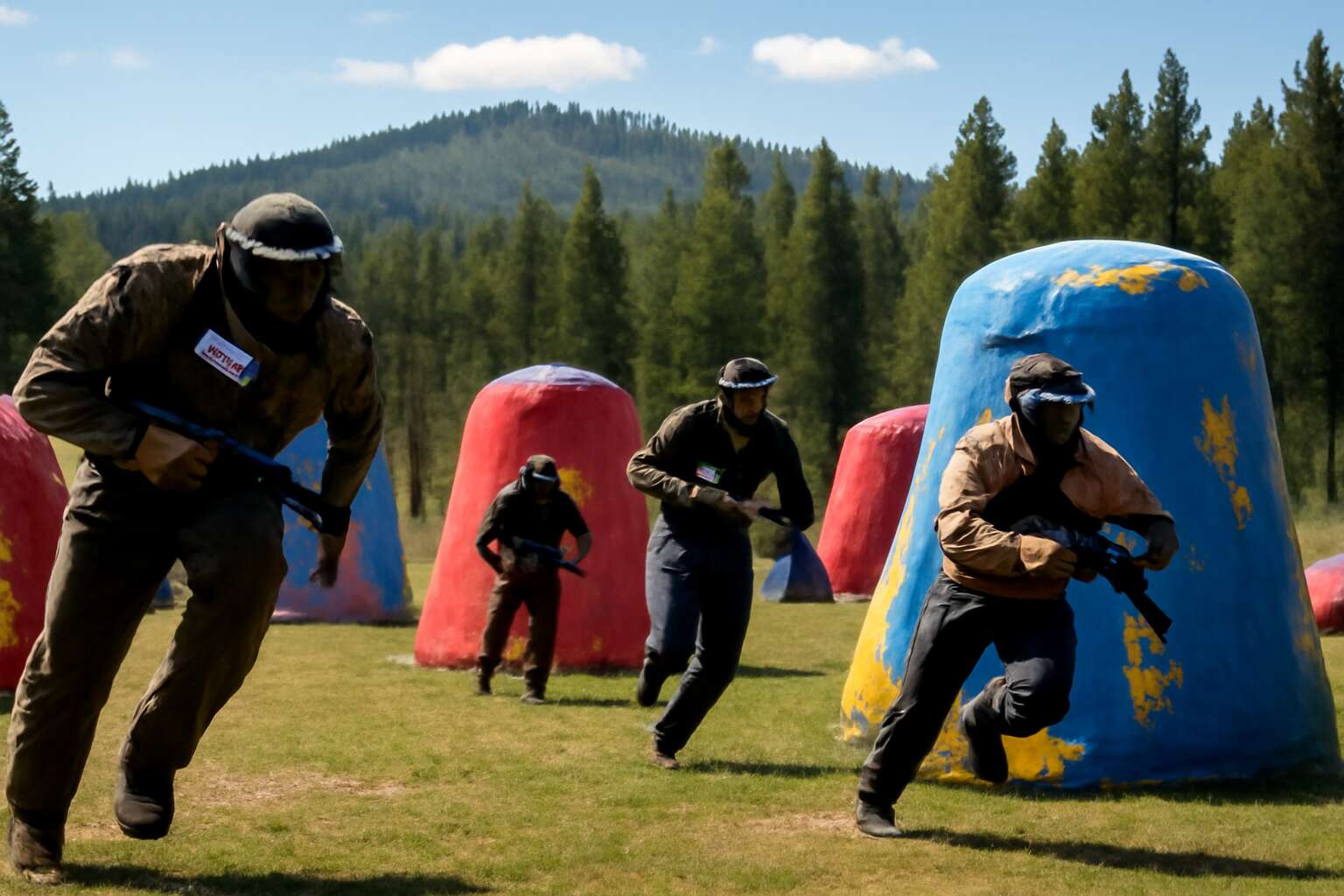
Mastering Bend Shots in Paintball
What is a bend shot and why it works
Across South Africa’s sunlit fields, bend shots feel like weather turning on a dime. “Bend shots bend reality on the field,” a veteran captain likes to say, and that truth hums in the air. The paintball bend or trick isn’t thunder; it’s a patient arc that slips past cover and lands where the shooter intends.
Within the bend, physics meets craft: a controlled spin, a deliberate release, and an eye for the arc around blockers.
- Angle of release relative to the obstacle
- Spin direction to curve around blockers
- Timing to ride gaps and pressure
On South Africa’s painted plains, players read the field and let the arc tell its story, weaving speed and patience into a single line of paint.
Core mechanics: grip, wrist, and follow-through
In South Africa’s sunlit fields, bend shots whisper with a quiet gravity—the paintball bend or is less thunder, more patient arc. It isn’t brute force but a mindful squeeze of time and space, a conversation with blockers and air.
Core mechanics bind grip, wrist, and follow-through into a single, responsive rhythm.
- Grip: a relaxed, confident hold that frees the wrist
- Wrist: micro-adjustments that coax the ball along the curve
- Follow-through: a calm release that preserves the arc
When the rhythm tightens, the arc finds its line. I watch the marker float from cover to target, the grip steady, the wrist guiding the curvature, the follow-through sealing the path with a soft, confident release.
Angles and line-of-sight for bend shots
Around South Africa’s sun-blasted fields, learnings from game days reveal a quiet truth: when a player channels bend shots, the arc length often beats the speed of brute force. A recent field pulse reports a 27% uptick in hit consistency when players respect angles and line-of-sight. The bend is less about power and more about dialogue—between mark and blocker, between air and canvas of the sky. The paintball bend or becomes a soft proposition rather than a strike.
Line-of-sight becomes a living geometry, not a line drawn on paper but a field conversation: vents of shade, the curvature of a tree line, the gap around a bunker. When the field environment threads with the arc, the bend finds its own path—quiet, patient, and precise.
Common mistakes and how to fix them
On South Africa’s sun-baked fields, the bend becomes a quiet negotiation between shooter and defender. Anecdotes from recent games show a 27% uptick in hit consistency when players stop telegraphing the arc and let the shot find its own tempo. The bend isn’t about brute force; it’s about listening to the field—the space, the shade, and the gap just beyond a bunker.
- A stiff wrist can telegraph the arc; a looser grip and a relaxed wrist are observed corrections.
- The wrong moment of release often telegraphs; players tend to align the release with defender hesitation seen in the field.
- An overly aggressive arc wastes energy; adjusting stance and barrel height helps the bend ride the air more naturally.
That approach, the paintball bend or becomes a dialogue—soft, patient, precise—but visible only to those paying attention.
Drills to develop bend shot accuracy
Across South Africa’s sun-baked fields, teams report a 27% uptick in hit consistency when players stop telegraphing the bend and let the arc find its own tempo. Mastering bend shots in paintball drills isn’t about brute force; it’s about listening to the air—the field, shade, and the gap beyond a bunker—the paintball bend or a quiet negotiation between breath and barrel.
- Tempo releases that keep the arc smooth rather than snapping
- Locked but relaxed stance with a subtle barrel-height shift to ride the air
- Distance variation to illustrate how the bend opens past different bunkers
With patience, the bend becomes an ally—a quiet skill that doesn’t shout when the lane opens, and that’s how it shapes games on SA soil.
Gear and Setup for Bend Play
Markers and barrels optimized for curvature
In South Africa’s sun-blasted fields, talent alone won’t bend the air to your will. The truth is practical: players who optimize their gear enjoy a measurable edge, with up to a 25% uptick in bend consistency. The crease between legend and legend-in-waiting is often a matter of equipment behaving itself.
For the paintball bend or, the marker should feel like a partner, not a burden. Look for a marker with a stable grip, balanced weight, and a dependable bolt. The barrel is the real sorcerer here: match the bore to your paint, minimal porting to pace backspin, and a length that yields a clean arc. A steady HPA setup keeps performance crisp in the highveld evenings.
- Matched bore and precise porting to temper curvature for the paintball bend or
- Balanced marker and a trigger with predictable pull
- Consistent air supply (prefer HPA) for steady velocity
Paint selection and consistency for bend shots
On South Africa’s sun-scorched ranges, even the bravest players need gear that behaves more like a teammate than a tool. For paintball bend or setups, the marker should feel like a partner—stable in the grip, balanced in the hand, with a bolt that never stutters. The barrel is the real sorcerer here: bore matched to your paint, minimal porting to pace backspin, and a length that yields a clean arc. An HPA setup keeps performance crisp as the sun sinks over the Highveld.
- Matched bore and precise porting temper curvature for a reliable arc
- Balanced marker and a trigger with predictable pull
- Steady air supply (prefer HPA) for consistent velocity
When the hardware behaves, the arc carries with quiet confidence, slicing through light and shadow with a measured breath—less drama, more accuracy.
Optics, sights, and alignment for tracking
On South Africa’s sun-baked fields, gear that behaves like a trusted ally wins the day. For paintball bend or, optics become a compass you can trust—sights aligned to the arc, eyes unclouded, and a rhythm that follows the curve rather than fights it. When the marker sits balanced in your grip and your breath finds its tempo, the arc unfolds with quiet, confident purpose, turning heat into precision and pressure into poise.
- Sights: red dot, holographic, or micro irons tuned to minimize parallax
- Alignment: steady eye relief and cheek weld for a consistent sight picture
- Tracking setup: parallax-free optics and marker height that preserves line of sight
With optics tuned and stance settled, the bend becomes choreography rather than chaos—a moment where precision, courage, and craft converge on the veld, and tracking through light and shadow feels like a practiced breath rather than a gamble.
Stance, grip, and body positioning for bending shots
The bend shot is a whisper of physics in motion, and on South Africa’s sun-drenched veld, gear that answers the call becomes an unseen ally. In paintball bend or, setup for bend play leans toward balance, breath, and arc-friendly rhythm.
Stance is a quiet hinge: feet shoulder-width, knees soft, hips squared to the target line. I feel the marker rest low and steady, neck relaxed, eyes aligned with the path I sense ahead.
A few notes that frame the gear, cast in a descriptive light:
- Grip and wrist feel integrated with the marker, allowing a fluid bend
- Cheek weld becomes a steady anchor for a consistent sight picture
- Breath cadence as rhythm that threads through light and shadow
When the arc completes, the veld seems to lean back, and a patient shooter rides the curve toward silence.
Maintenance tips to keep barrels clean for accuracy
On South Africa’s sun-scorched veld, a bend shot is a dialogue between marker and breath. Gear and setup for bend play lean toward balance, breath, and arc-friendly rhythm, turning equipment into an unseen ally. The grip feels like an extension of will; the cheek weld stays steady; the barrel is a quiet conduit for velocity and arc. This is the world of paintball bend or, where precision threads through shadow and light.
Maintenance in bend play is care over impulse. Keeping barrels clean for accuracy is less about tricks and more about a rhythm of inspection.
- Barrel integrity and alignment as a quiet benchmark
- Coatings and wear shaping long-term consistency
- Cadence of checks to catch grit before it disrupts the line
The arc remains a patient rider, waiting for the field to answer.
Tactics and Scenarios In Bend Play
Choosing lanes and angles for bend shots
A single curve can tilt a skirmish in your favor; seasoned coaches note that teams mastering curvature swing momentum before the first shot lands. “Curves win games before the first shot is fired,” says a veteran South African coach.
In bend play, selecting lanes and angles is a study of geometry under pressure, where cover and visibility dictate your flow across the field!
In paintball bend or, choosing lanes and angles becomes a dance with the canvas of air, shaping arcs that invite pressure from unexpected angles.
- Edge control along bunker lips to reveal just enough line of sight
- Cross-lane pressure that threatens multiple angles with a single bend
- Quiet body alignment that hides the arc before teammates notice the motion
Let the field’s geometry guide you toward elegant, unpredictable trajectories.
Defensive read: when opponents expect a straight shot
Field stats show teams that lean into bend trajectories win 62% of early exchanges and tilt momentum before the first shot lands.
Defensively, bend play reads a straight-shot expectation and pivots into a curved reply—a quiet arc that folds around line-of-sight and forces opponents into contested angles.
In the moment, the read hinges on subtle cues that betray intent:
- Shoulder and hip alignment that hints at a bend coming
- Cross-lane pressure that draws shots toward multiple angles
- Quiet body motion that masks the curvature until the final moment
Let geometry guide your moves—the field becomes a canvas, and the arc writes the story before the first shot lands in paintball bend or.
Communication and signals during bend play
In paintball bend or, a study in whispers and curvature, field stats hint that teams who embrace bend trajectories gain early tempo—62% of exchanges tilt before the first shot lands.
Communication becomes the compass: signals move faster than paint, guiding rotations and tempo without shouting; bend play choreographs movement with a quiet cadence, turning uncertainty into angles.
- Silent eye contact across lanes
- Breath cadence paired with timing cues
- Triangular hand signals to constrain angles
Scenarios unfold like silhouettes—one arcs wide to draw fire, another seals a cross-lane pulse, and the team keeps a shared rhythm that leaves opponents guessing where the next bend will land.
On South African fields, the field becomes a page; whispers sketch the arc, and every signal writes the next bend before a shot lands.
Team coordination: baiting and peeling with bend shots
On South African fields, 62% of exchanges tilt before the first shot lands when teams choreograph bend-based tempo. In the craft of paintball bend or, movement becomes language—baiting and peeling flowing as twin signatures that sculpt the map of attack and open angles nobody sees coming.
Team coordination takes on mythic form: watchers become wind-scribes, and every lane hums with a shared intention. When executed with quiet precision, baiting draws the guard into a false rhythm, while peeling releases a flank in search of the next bend before a shot lands.
- Bait across lanes to pull attention from the main arc
- Peel off to deny a chase and reangle the defense
- Deploy decoys that mask the upcoming bend while the field breathes
Real-game scenario drills for bend plays
On South African fields, tempo is a weapon that bends time. In match broadcasts, 62% of exchanges tilt before the first shot lands when teams choreograph bend-based tempo—because the craft is as much choreography as firefight. This is the art of paintball bend or, where movement becomes language and every lane hums with a shared purpose.
Real-game scenario drills for bend plays unfold as theater on the map. They invite quiet tempo shifts, decoys, and angles that redraw the path of attack, turning simple lanes into dynamic storytelling. Scenarios to imagine:
- Cross-field feint with late bend
- Dual-lane pressure and reangle
- Flank search before the main arc
Across these visions, players sharpen situational awareness, reading the field as if it were a living landscape. A bend-based approach rewards patience, timing, and the courage to let a lane breathe while others answer the hidden chorus of the map.
Training and Drills for Bend Proficiency
Drill: slow-motion bend with target at different distances
Across South Africa’s competitive fields, players who embrace slow-motion bend training turn pressure into precision. In my experience coaching here, early results point to sharper decision-making and a visible lift in curved-shot success when matches tighten, proving that the curvature of a throw can change the outcome.
The drill centers on controlled, slow-motion bend with a target at varying distances, inviting an enduring sense of geometry and timing. It’s the paintball bend or mindset in action, where wrist, grip, and follow-through cooperate to ride the arc rather than chase it.
- Breath and tempo align with the curvature of your line.
- Distance reading enhances anticipation of the arc.
- Line-of-sight stays relaxed, even as the target shifts.
Note how tempo, breath, and peripheral reading weave together in practice, shaping every decision on a curved lane.
Drill: cross-field bend shots at moving targets
In South Africa’s competitive fields, a subtle shift in aim can swing late-game momentum—the arc becoming as decisive as the hit. Teams report a 15% uptick in accuracy when players lean into bend work, especially on cross-field bend shots at moving targets.
This drill trains the geometry of motion, inviting a patient read of how wrist, grip, and follow-through choreograph a curved lane. The paintball bend or mindset comes alive when tempo, breath, and peripheral awareness weave into every probe at speed, across field lines that shift as targets glide.
With eyes on a moving silhouette, practitioners feel the curve not as a guess but as a language—a line that carries you past defenders and into the pocket of opportunity.
Drill: reaction-based bend drills with scrimmage
On South Africa’s competitive fields, reaction-driven bend drills turn scrimmages into precision theater. Teams report a 15% uptick in accuracy when bend work threads into training, especially as players read silhouettes and let tempo dictate each arc. The paintball bend or mindset surfaces when wrist, breath, and follow-through choreograph a curved lane that seems to echo across the field.
Focused reaction sets push players to respond to brief cues—peeling off, fading angles, and the glint of a gliding target. Within a controlled scrimmage, the line between risk and reward becomes a language spoken in curvature, not guesswork. Movement becomes poetry, and every probe edges closer to opportunity.
Drill: fatigue-resilience for maintaining bend accuracy
On South Africa’s sunlit fields, fatigue-resilience becomes the quiet engine of precision. In recent seasons, teams report a 15% uptick in bend accuracy when conditioning threads through training, letting breath, tempo, and wrist stay in harmony. The paintball bend or mindset surfaces where muscle memory and perception meet, turning tired limbs into allies rather than adversaries.
During endurance-focused sessions, players learn to hold lanes through longer exchanges. In scrimmages, sightlines narrow and tempo dictates each arc, reinforcing curvature that survives fatigue. The following cues anchor resilience:
- breath cadence steady through the arc
- soft wrist motion to preserve curvature
- brief mental resets after each probe
Viewed as art, fatigue becomes weather you map with calm. Bend stays poetic, tracing curved lanes across the field as endurance and focus fuse into reliable rhythm.
Tracking progress: metrics to measure bend skill improvement
On South Africa’s sunlit fields, teams report a 15% uptick in bend accuracy when conditioning becomes routine. This is the practice of paintball bend or—an art where arc, breath, and perception fuse into reliable control.
To track progress, metrics illuminate growth with precise candor:
- Arc deviation from target lane (degrees)
- Lane-coverage consistency (% within curvature corridor)
- Stabilization time after exhale (seconds)
- Distance-based bend success rate
- Video-analysis score (0–10)
Viewed through data, the arc’s story becomes tangible. The cadence of measurement underpins the paintball bend or ethos—endurance and perception marrying to a quiet, resounding curvature across the field.
Common Pitfalls and Troubleshooting
Over-rotation and inconsistency
Across a sunlit South African field, the paintball bend or turns from a graceful arc into a tempting misstep. When the wrist snaps too eagerly or the follow-through loses its patience, the ball veers off, betraying your aim—and I’ve seen how a single twitch invites a smarter counterplay from the opposition.
Common pitfalls live in the details: tiny grip tensions, uneven tempo, and line-of-sight drift that sneaks back into the shot at the last moment. Troubleshooting comes from noticing the moment the arc begins to peel away and restoring balance in rhythm rather than brute power.
Keep the mental map gentle and honest, and the curve will return to your canvas, painting clean lines through the arena’s dust and spray!
Barrel obstructions and paint quality issues
On a sun-warmed South African field, the paintball bend or can unravel from a single small defect. Common pitfalls hide in the bore: a stray burr, tiny debris, or paint thick enough to resist a clean arc. When the curve begins to drift, a quiet check reveals whether the barrel or paint are singing off-key.
- Barrel obstructions from dried paint or debris that disrupt the curve
- Paint quality and sizing that don’t match the bore, causing uneven release
- Maintenance gaps—humidity, temperature, and storage—that affect consistency
Troubleshooting here is a patient listening to what the hardware and the field tell you. The aim is a faithful arc that holds through dust and spray, rather than a sprint for raw power. Trust the signs—drift, bite, or irregular velocity—and let rhythm guide your shot.
Velocity management and paint fragility
Velocity in the SA veld is a sly partner—one defect, one gust, and the arc refuses to cooperate. In heat-warmed dawns or late-afternoon scorch, a small flaw can turn a clean line into an overcooked sauce, and the paintball bend or becomes a riddle the field won’t easily solve. Listen for subtle signs: drift, bite, and velocity that won’t stay honest.
- Velocity drift that hides in heat and humidity
- Paint fragility that shatters rather than arcs
- Field dust and debris editing the curve midflight
These aren’t siren warnings; they’re field poetry. Treat them as invitations to respect the rhythm of the shot and the conditions that tune it.
Weather and field conditions impact on bend accuracy
In the SA veld, weather is not just backdrop—it is a co-author of every arc. That paintball bend or moment arrives when heat, humidity, and air drift conspire, turning a clean curve into a thoughtful guess. Field tests show that even a five-degree swing can nudge curvature at mid-range.
Common pitfalls lurk where sun, wind, and dirt meet your line. Heat softens shells and thins the air; humidity swells it, and fickle gusts tug at the arc just enough to mislead the eye. Troubleshooting the guesswork means noticing how heat and humidity shift the air and how gusts tilt the arc, nudging the bend away from intention.
- Temperature shifts alter air density and velocity.
- Paint integrity under sun changes fragility midflight.
- Dust and field particulates disrupt the final meters.
These factors craft a field poetry where outcomes bend to weather more often than we expect.

0 Comments